

When Medicine Was Worse Than the Disease
Medicine has always had a difficult job.
A patient arrives sick, frightened, bleeding, feverish, coughing, or otherwise having a profoundly bad day, and someone has to decide what to do about it.
Today, that decision might involve antibiotics, imaging, laboratory tests, surgery, or medication backed by clinical trials.
For much of human history, however, the available options were considerably more adventurous.
Drain some blood.
Push the cloudy lens of an eye out of the way with a needle.
Fill part of the chest with plastic balls.
Blow tobacco smoke into a drowning victim’s rectum.
And if none of that works, Pliny the Elder has several suggestions involving urine.
To be fair to the physicians of the past, most were working with the best explanations available to them. Anatomy was incomplete. Microorganisms were invisible. Clinical trials did not exist. Disease could be explained through humours, poisonous air, supernatural influence, blocked bodily fluids, or theories that seemed entirely reasonable until someone eventually proved otherwise.
The result is a medical history filled with treatments that range from surprisingly sensible to spectacularly unfortunate.
Here are eight of them.
1. Bloodletting: Perhaps You Simply Have Too Much Blood
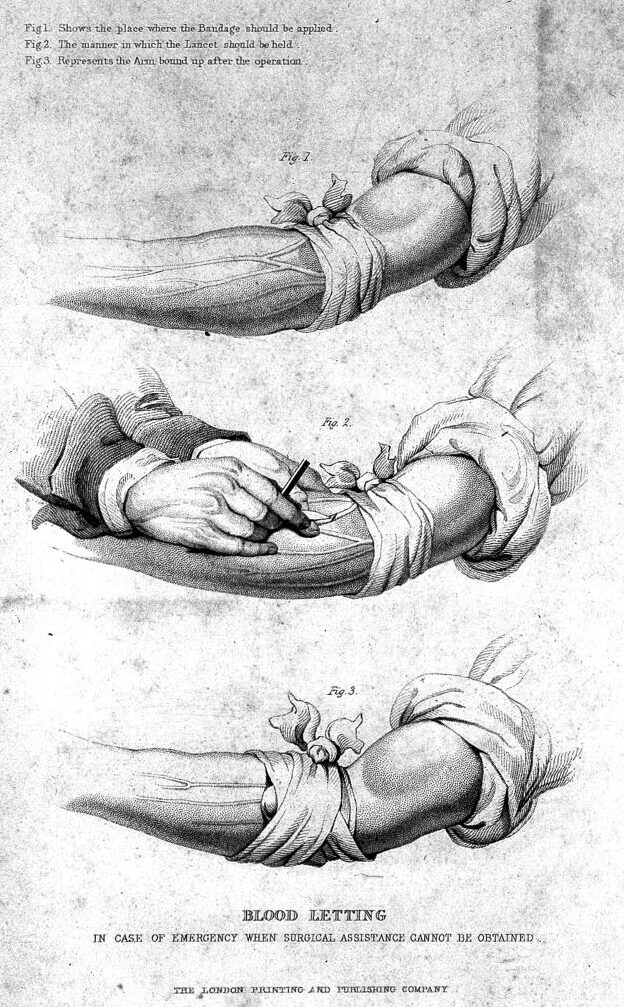
Few treatments enjoyed a career as long as bloodletting.
For more than two thousand years, physicians deliberately removed blood to treat illness. The practice became closely tied to humoral medicine—the ancient Greek idea that health depended on the proper balance of blood, phlegm, yellow bile, and black bile.
If those fluids became unbalanced, illness followed.
And blood, unfortunately for the patient, was relatively easy to remove.
Physicians used lancets, cupping instruments, and eventually enormous quantities of medicinal leeches. Bloodletting was prescribed for fevers, inflammatory illnesses, neurological complaints, and a remarkable assortment of other conditions.
The practice survived well beyond antiquity. Medieval physicians used it. Renaissance physicians used it. Some of the most respected doctors of the early modern period defended it.
Only during the nineteenth century did therapeutic bloodletting finally begin its long retreat from routine medicine.
Interestingly, removing blood itself did not disappear. Modern therapeutic phlebotomy is still used for specific conditions such as iron overload.
The important difference is that we no longer assume a fever means your blood supply has become overly enthusiastic.
2. Trepanation: A Hole in the Head, Quite Literally
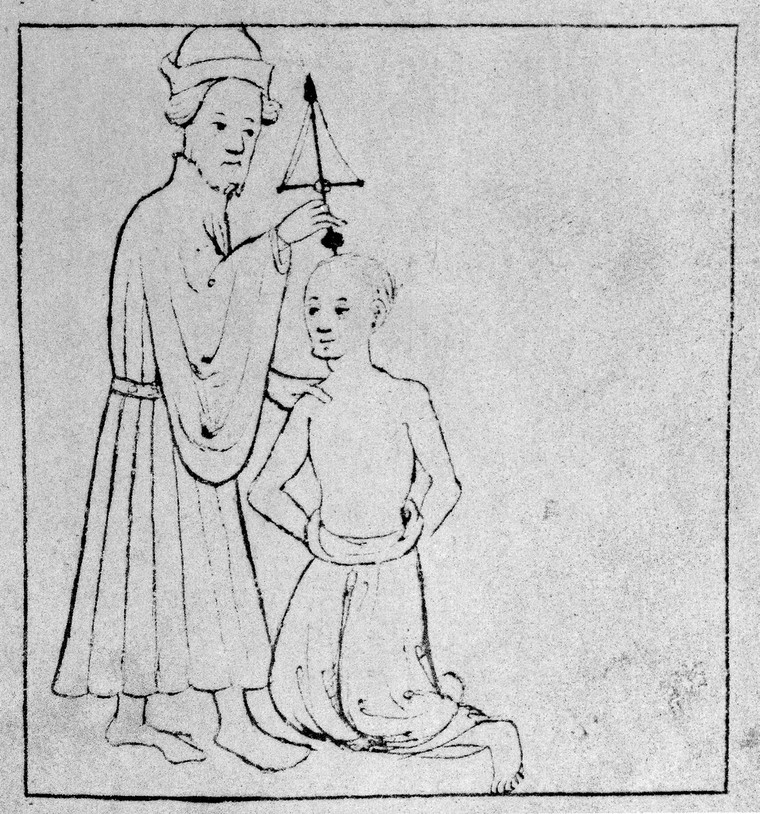
Trepanation is one of the oldest known surgical procedures.
It involves cutting, scraping, or drilling an opening into the skull.
Archaeologists have discovered trepanned skulls from numerous cultures around the world, some thousands of years old. Even more remarkably, many show signs of bone healing, meaning their owners survived the procedure.
Why people performed trepanation varied.
Some cases may have been attempts to treat head trauma or relieve pressure after an injury. Ancient medical writings also mention trepanation in connection with particular neurological problems and skull fractures. In other periods, spiritual explanations—such as allowing harmful forces to escape—became associated with the practice.
One popular modern story claims prehistoric doctors routinely drilled holes in skulls to cure migraines. The evidence for that particular claim is surprisingly weak.
The holes, however, are very real.
And some people walked around for years afterward with part of their skull permanently missing.
Suddenly your copay seems slightly less offensive.
3. Cataract Couching: Move the Problem Somewhere Else
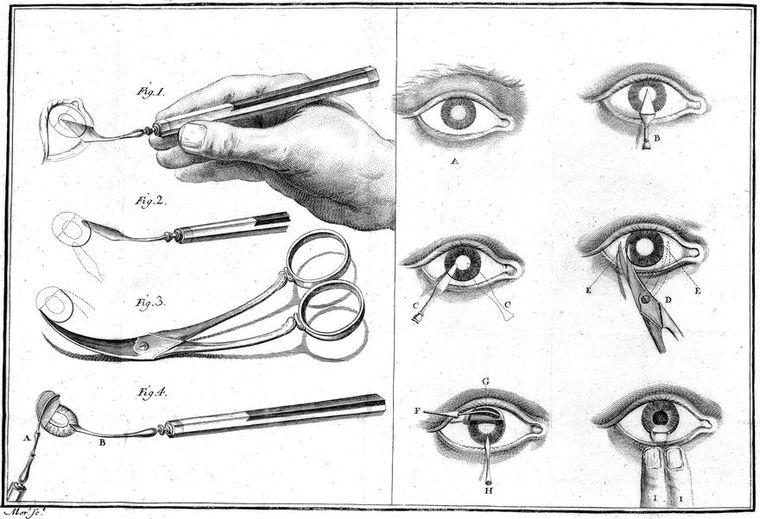
Cataract surgery is ancient.
Modern cataract surgery removes the cloudy natural lens and usually replaces it with an artificial one.
Older surgeons had another solution:
Move the cloudy lens out of the way.
The technique was known as couching.
A sharp instrument was inserted into the eye and used to displace the opaque lens downward and away from the visual axis. The cataract remained inside the eye; it simply stopped blocking light in the same place.
Versions of the procedure appear in ancient Indian and Greco-Roman medical traditions. The Roman writer Celsus described couching, and similar procedures appear in Sanskrit medical literature associated with the Sushruta Samhita.
In successful cases, a patient who had been unable to see could suddenly perceive light and objects again.
There were, naturally, some drawbacks.
The patient had just had an instrument pushed into the eye. The displaced lens remained inside. Infection, inflammation, glaucoma, retinal damage, and eventual blindness were possible outcomes.
Still, in a world without modern ophthalmology, even imperfect restoration of sight could have seemed miraculous.
4. Urine: Pliny Has Entered the Consultation
At some point during the first century CE, Roman author Pliny the Elder sat down to compile an enormous encyclopedia of the natural world.
The result was Natural History.
And once Pliny reached Book XXVIII, things became interesting.
He devoted an entire chapter to remedies derived from urine.
Among the treatments he recorded were urine preparations for burns, skin eruptions, sores, scorpion stings, eye complaints, bites, and other ailments. He even reported the belief that a person’s own urine could be particularly useful for that person’s injuries.
This doesn’t necessarily mean every Roman physician was enthusiastically prescribing urine for everything. Pliny was a compiler: he collected claims, traditions, observations, folk remedies, and beliefs from many sources, and he was not equally convinced by all of them.
But the remedy is not something a modern blogger invented for clicks.
You can go directly to Natural History, Book XXVIII, Chapter 18, and find Pliny discussing it himself.
That is one of the great pleasures of medical history.
Sometimes the original source is considerably stranger than the internet summary.
From the Old Books
Pliny the Elder, Natural History, Book XXVIII, Chapter 18 — “Remedies Derived from the Urine.”
Nearly two thousand years later, the chapter remains available in digitized editions.
The receipts survived.
5. Tobacco Smoke Enemas: Resuscitation Took an Unexpected Turn
Imagine pulling an apparently drowned person from a river in eighteenth-century Europe.
They are cold.
They are unresponsive.
They are not breathing normally.
Fortunately, someone nearby has emergency equipment.
Unfortunately, that equipment includes tobacco and a tube intended for the rectum.
Tobacco smoke enemas became a recognized resuscitation technique during the eighteenth century. Smoke was blown into the rectum in the belief that tobacco’s stimulating properties and warmth could help revive drowning victims.
This was not merely some isolated folk remedy.
Resuscitation organizations promoted the technique, and equipment for administering tobacco smoke enemas was placed at locations along waterways—including the River Thames.
Eventually, doubts about its effectiveness grew and other methods replaced it.
It has, however, left the English language with perhaps the most medically appropriate origin story imaginable for the expression:
“blowing smoke up your arse.”
History occasionally provides its own punchline.
6. Mercury for Syphilis: The Cure That Could Poison You Too
Mercury had a remarkably long medical career.
One of its most famous uses was the treatment of syphilis.
From around the end of the fifteenth century onward, mercury became one of the major therapies used against the disease and remained important for centuries.
Patients could receive mercury through ointments, fumigation, oral preparations, and other methods.
There was one significant problem.
Mercury is toxic.
Treatment could cause excessive salivation, mouth and gum damage, neurological problems, kidney injury, and other signs of mercury poisoning. Distinguishing symptoms of the treatment from symptoms of advanced disease was not always straightforward.
Yet mercury remained part of syphilis therapy for roughly four centuries.
The history eventually produced a grim saying:
“A night with Venus, a lifetime with Mercury.”
Better treatments followed—including arsenical compounds in the early twentieth century—and penicillin transformed syphilis treatment in the 1940s.
For generations before that, however, surviving the treatment could become its own medical challenge.
7. Soothing Syrups: Because the Baby Was Apparently Not Calm Enough
Patent medicines of the eighteenth and nineteenth centuries frequently promised relief from teething, colic, diarrhea, sleeplessness, and the general inconvenience of an infant behaving like an infant.
Some preparations worked exceptionally well at making children quiet.
There was a reason.
They contained opiates.
Products such as Godfrey’s Cordial were given to infants and children and contained opium. Other soothing preparations later contained morphine or similar narcotics.
Parents were not necessarily behaving recklessly by the standards of their time. These products were openly sold as medicines, drug regulation was limited, and consumers could reasonably assume that something marketed for children was suitable for children.
Unfortunately, dosing potent narcotics in infants could result in respiratory depression, overdose, and death.
The bottles promised tranquility.
They were not terribly specific about how tranquil.
8. Plombage: Filling the Chest to Collapse a Lung
By the twentieth century, medicine had microscopes, X-rays, laboratories, and increasingly sophisticated surgery.
It also had tuberculosis.
Before effective antibiotic treatment became widely available, physicians experimented with ways of “resting” diseased lungs.
One approach was collapse therapy.
If the affected portion of lung could be deliberately collapsed, doctors hoped it would heal and limit the spread of tuberculosis.
One particularly striking version was called plombage.
Surgeons created a space inside the upper chest and packed it with material to compress the diseased lung. Various substances were used over time, including paraffin wax, oil, rubber materials, and eventually hollow Lucite balls.
Yes.
Some patients with tuberculosis spent decades carrying what looked remarkably like a collection of ping-pong balls inside their chest.
The procedure declined after effective antimicrobial therapy transformed tuberculosis treatment.
But the story did not always end there. Decades later, some former patients developed complications when plombage material migrated, became infected, compressed nearby structures, or eroded into surrounding tissues.
Modern case reports have documented surgeons removing Lucite balls more than half a century after they were implanted.
Medical history occasionally refuses to remain historical.
Were People in the Past Really This Bad at Medicine?
Not exactly.
It is tempting to look backward and laugh—which, admittedly, Leech House intends to do from time to time.
But historical medicine becomes far more interesting when we resist the idea that everyone before us was simply stupid.
They observed.
They experimented.
They inherited explanations from earlier physicians.
They occasionally discovered treatments that genuinely worked.
And sometimes they continued using treatments for centuries because improvement, coincidence, natural recovery, tradition, authority, and genuine therapeutic effect were extraordinarily difficult to separate.
There were no randomized controlled trials.
There were no germ cultures.
There were no CT scanners.
Often there wasn’t even agreement about where particular organs were located or what they did.
Doctors were trying to solve a puzzle while several pieces—and occasionally the entire picture on the box—were missing.
That is what makes bizarre medical treatments worth studying.
They are not just stories about ridiculous things people once believed.
They show how humans build explanations from the evidence available to them, how difficult bad ideas can be to dislodge, and how today’s obvious truth can begin as tomorrow’s outrageous suggestion.
And if history offers any reassurance, it is this:
Future generations will almost certainly look back at some part of modern medicine and ask exactly the same question we ask about tobacco smoke enemas.
They did WHAT?
Sources & Further Reading
Primary historical source
Pliny the Elder. Natural History, Book XXVIII, especially Chapter 18, “Remedies Derived from the Urine.”
Historical and medical scholarship
National Library of Medicine — historical material on bloodletting and the four humours.
Celsus. De Medicina — ancient description of cataract couching and other surgical procedures.
Historical research on cataract surgery comparing early Greco-Roman and Sanskrit sources, including the Sushruta Samhita.
Historical studies of trepanation and archaeological evidence from ancient societies.
Historical studies of tobacco-smoke enemas and eighteenth-century drowning resuscitation.
Medical-history research on mercury treatment for syphilis.
Historical literature on opium-containing patent medicines used for infants and children.
Medical case literature describing tuberculosis collapse therapy and long-term complications of Lucite-ball plombage.
Leech House examines historical medical beliefs and practices for educational purposes. Historical remedies described here are not medical advice and should not be attempted.