
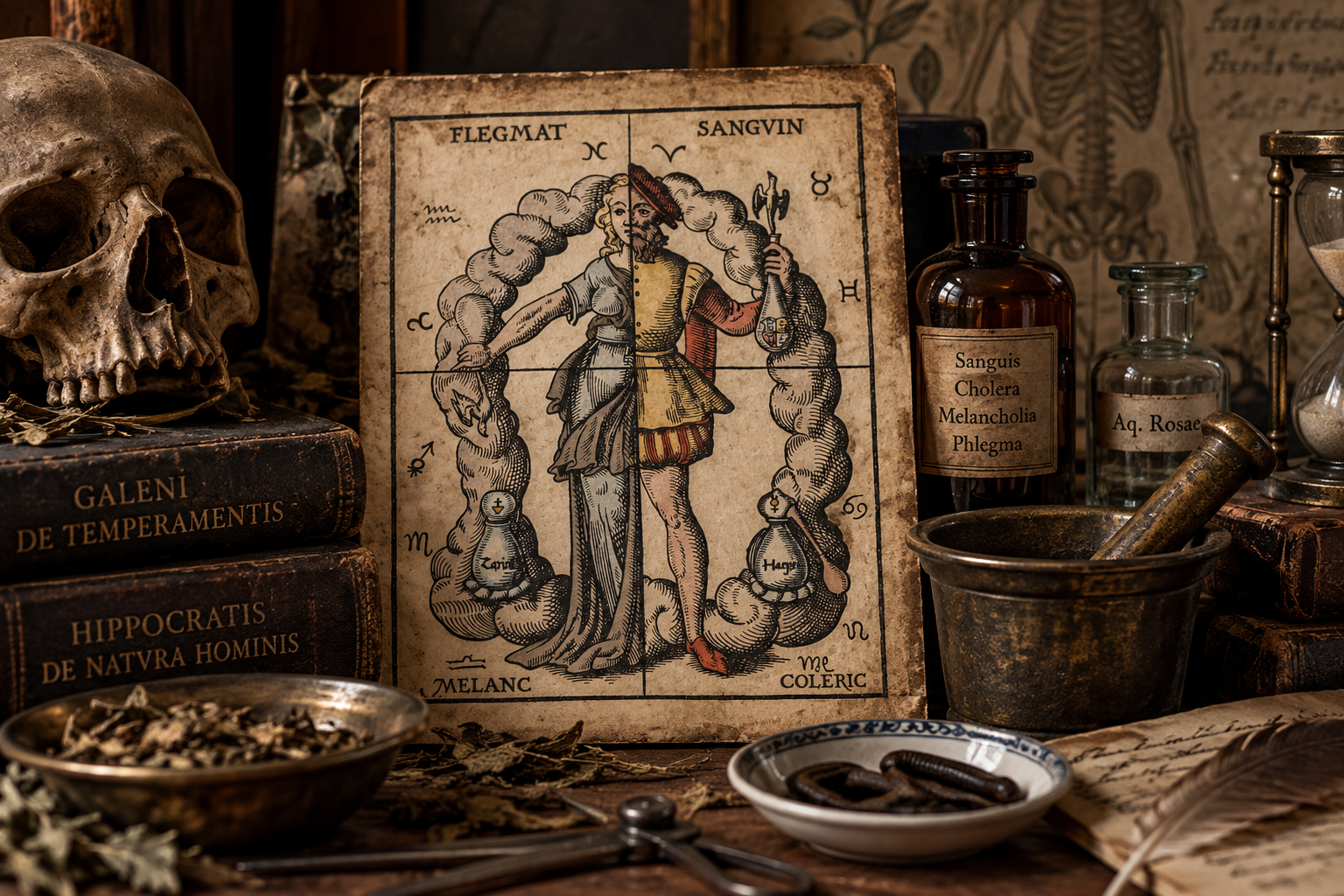
The Four Humours: When Your Personality—and Your Illness—Was Blamed on Bodily Fluids
Feeling gloomy?
Too much black bile.
Irritable?
Yellow bile may be getting ambitious.
Unusually cheerful, romantic, and energetic?
Congratulations. Your blood is apparently thriving.
For centuries, physicians across Europe and the Mediterranean worked within a medical system built around the idea that health depended on the balance of bodily fluids known as humours.
There were four:
Blood. Phlegm. Yellow bile. Black bile.
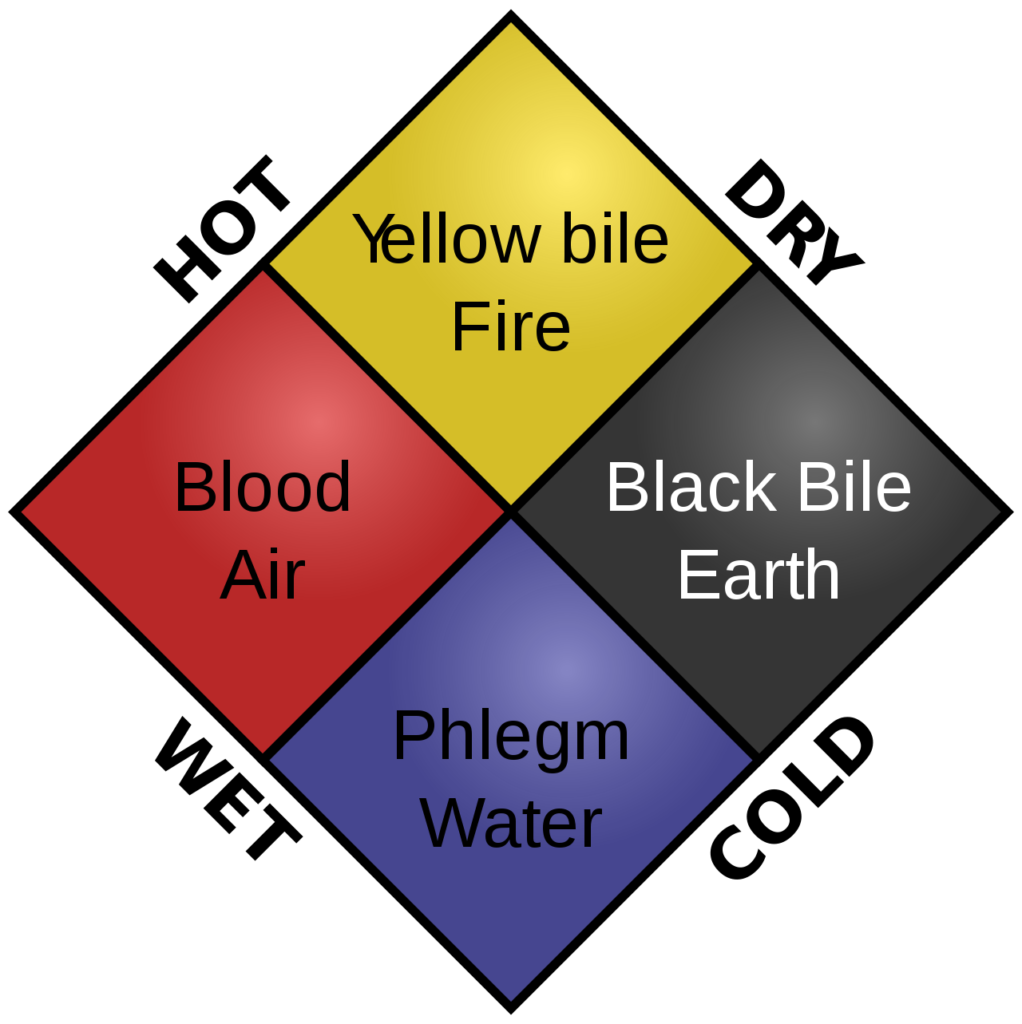
They were not simply substances inside the body. Within humoral medicine, they became part of an enormous explanatory system connecting illness, temperament, diet, environment, age, season, and even the qualities of hot, cold, wet, and dry.
If the humours remained in appropriate balance, you were healthy.
If they did not, something had gone wrong.
And your physician now had to figure out which fluid was misbehaving.
Where Did the Four Humours Come From?
The story is usually reduced to:
Hippocrates invented the four humours.
The real history is messier.
The Hippocratic Corpus, a collection of ancient Greek medical writings associated with Hippocrates and his followers, contains several different ideas about what caused disease. Ancient Greek physicians were not all working from one universally accepted theory.
One particularly important text, On the Nature of Man, describes the human body as containing four major fluids:
blood, phlegm, yellow bile, and black bile.
The treatise argues that health depends on their proper mixture and proportion, while illness can occur when one humour becomes excessive, deficient, isolated, or improperly distributed.
That became extraordinarily influential.
But the four-humour system was only one ancient medical theory among several, and historians caution that it did not instantly become the universal Greek medical model it is sometimes portrayed as today.
Then Galen arrived.
And things became considerably more organized.
Galen Turns Humours Into a System
Galen of Pergamon, who lived during the second century CE, became one of the most influential physicians in Western medical history.
He studied and interpreted Hippocratic medicine and developed humoral ideas into a much more elaborate framework.
The four humours became associated with qualities:
| Humour | Qualities | Temperament |
|---|---|---|
| Blood | Hot and wet | Sanguine |
| Yellow bile | Hot and dry | Choleric |
| Black bile | Cold and dry | Melancholic |
| Phlegm | Cold and wet | Phlegmatic |
Galen’s writings tied these ideas to bodily constitution, disease, treatment, and temperament. The National Library of Medicine preserves a 1545 edition of his De temperamentis—On the Temperaments—which explicitly develops these connections.
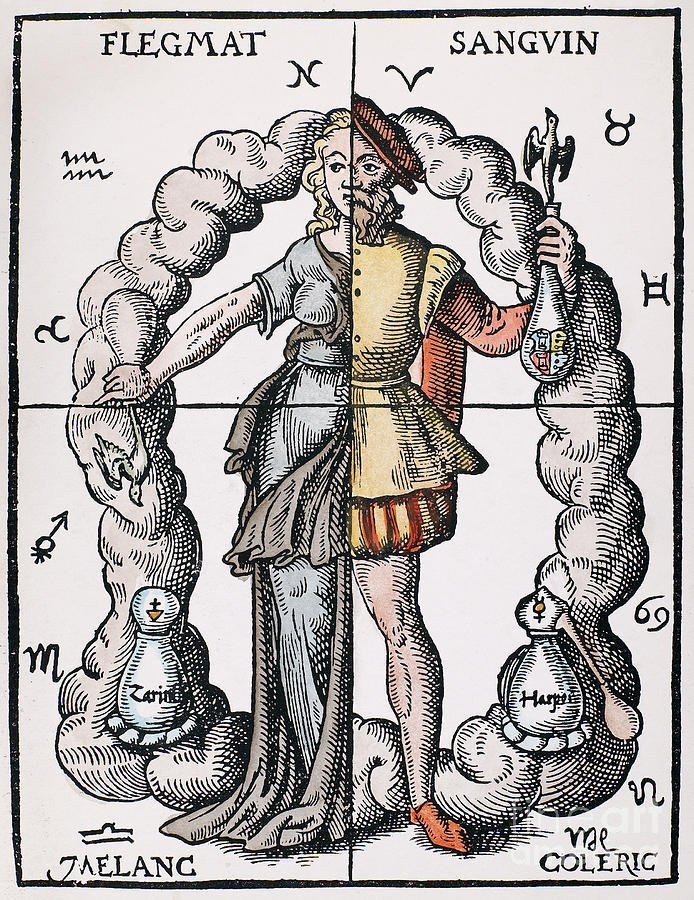
This system would become enormously influential in medieval and early modern medicine.
Not for decades.
For centuries.
Blood: The Sanguine Humour
Blood was considered hot and wet.
A person in whom blood predominated might be described as sanguine—hopeful, sociable, energetic, courageous, affectionate, or amorous.
Even today, sanguine can mean cheerful or optimistic.
That linguistic fossil comes from this older medical worldview.
Too much blood, however, could theoretically produce illness.
Which created a rather obvious treatment.
Remove some.
Bloodletting became one of the most recognizable therapies associated with humoral medicine. Physicians could open a vein, apply cups, or use leeches in an attempt to remove what they considered an unhealthy excess.
The National Library of Medicine notes that maintaining humoral balance became closely linked with bloodletting in early medicine.
In other words:
If blood was the problem, medicine had a very direct solution.
Yellow Bile: The Choleric Humour
Yellow bile was hot and dry.
Its associated temperament was choleric.
A choleric person might be irritable, quick-tempered, forceful, or easily angered.
The relationship survives in English.
The word choleric still means bad-tempered or irritable.
And choler itself once referred both to yellow bile and anger.
Under humoral reasoning, a physician might attempt to counter excessive heat and dryness with treatments believed to possess opposing qualities.
This principle—treating excess with its opposite—became central to much humoral therapy.
Too hot?
Cool it.
Too dry?
Moisten it.
Too much of a particular humour?
Find a way to reduce or evacuate it.
Elegant as a system.
Less elegant for the patient.
Black Bile: The Melancholic Humour
Black bile was associated with cold and dry qualities.
Its temperament was melancholic.
And yes:
That is where we get the word melancholy.
The Greek term behind it essentially refers to black bile.
A melancholic temperament became associated with sadness, fearfulness, introspection, despondency, and gloom.
So an emotional state that we now understand through psychology, psychiatry, neurology, circumstance, and countless other factors could once be interpreted physiologically:
Perhaps there was simply too much black bile.
There is an interesting complication, though.
What exactly ancient physicians meant by “black bile” was not always straightforward. Even Galen discussed ambiguity around the term and distinguished different ways it could be understood.
Humoral medicine was more intellectually complicated than the neat four-box chart we usually inherit today.
Phlegm: The Phlegmatic Humour
Phlegm was cold and wet.
Someone considered phlegmatic was calm, unemotional, slow-moving, reserved, or difficult to excite.
Again, the word survived.
Calling someone phlegmatic today still means they are notably calm or composed.
Within the old medical system, however, those personality traits were not simply psychological.
They reflected constitution.
Your body and personality were thought to belong to the same physical system.
That distinction between “mental” and “physical” illness that feels so familiar to us was not necessarily drawn in the same way.
The fluids inside you could help explain both.
So How Did a Doctor Diagnose an Imbalance?
There was no laboratory panel for black bile.
Physicians instead relied on observation.
They considered things such as:
- the patient’s symptoms
- pulse
- urine
- stools
- appetite
- sleep
- complexion
- age
- sex
- season
- climate
- diet
- emotional state
- habitual temperament
A physician might decide that an illness was hot, cold, wet, dry—or some combination—and then choose treatment intended to restore balance.
Humoral medicine could therefore become highly individualized.
Two patients with what we would now diagnose as the same disease might receive different treatment because their constitutions were believed to differ.
It sounds foreign.
Yet the underlying question is oddly familiar:
What kind of patient has this disease, and what is happening specifically in their body?
The explanation was wrong.
The impulse to individualize treatment was not necessarily foolish.
And Then Came the Treatments
Once imbalance had been identified, the physician’s job was to restore equilibrium.
That might involve:
Diet
Food was not merely nutrition. Foods themselves could be classified according to qualities such as hot, cold, wet, or dry.
A patient’s diet could therefore be adjusted to counteract their perceived imbalance.
Bloodletting
If excessive blood—or sometimes other conditions interpreted through humoral logic—was suspected, blood could be removed.
Purging
Laxatives were used to evacuate unwanted material through the bowels.
Vomiting
Emetics could be given to expel harmful or excessive humours.
Sweating
Inducing perspiration could also be interpreted as helping remove unwanted matter.
Herbal medicines
Plants were chosen partly for qualities believed to oppose the patient’s condition.
Your old Leech House notes describe exactly this underlying logic: illness as imbalance, with diet, herbs, vomiting, enemas, and bloodletting used to restore equilibrium.
If there was something inside you that should not be there—or too much of something that belonged there—the obvious solution was often to get it out.
Preferably through whichever exit was currently available.
From the Old Books
One of the primary texts behind the four-humour tradition is:
Hippocratic Corpus — On the Nature of Man
The text describes the body in terms of blood, phlegm, yellow bile, and black bile and links health to their proper mixture.
Later, Galen developed these ideas extensively.
One particularly relevant work is:
Galen — De temperamentis (On the Temperaments)
A surviving 1545 printed edition held by the National Library of Medicine shows just how long these ancient ideas remained important enough to print, study, and preserve.
This is one of those moments where Leech House can say:
No, we didn’t make the bile thing up. Here is the book.
Why Did This Theory Last So Long?
This is perhaps the most interesting question.
From our position, knowing about bacteria, viruses, hormones, immune systems, genetics, biochemistry, and cellular pathology, humoral medicine can seem obviously wrong.
But imagine trying to explain disease without any of those concepts.
You can see blood.
You can see mucus.
You can see vomit.
You can see bile.
You can watch fever make someone hot.
You can watch dehydration make them dry.
You can watch respiratory disease produce phlegm.
You can see people become flushed, pale, sweaty, lethargic, restless, or delirious.
A theory based around bodily fluids and observable qualities was not pulled entirely from nowhere.
It offered physicians a coherent system.
It explained symptoms.
It suggested treatments.
It incorporated environment and diet.
It connected physical and emotional health.
And, perhaps most importantly, some patients recovered after treatment.
Of course, people also recover without treatment.
That distinction was considerably harder to establish before controlled clinical trials.
Galen’s Very Long Shadow
Galen’s influence became enormous.
His writings were copied, translated, studied, debated, and transmitted through the Greek, Byzantine, Islamic, and Latin medical traditions.
Humoral medicine therefore became much bigger than one Greek physician or one ancient book.
By the medieval and early modern periods, humoral thinking had become deeply embedded in European medicine and culture.
It influenced how physicians thought about:
disease,
diet,
personality,
mental states,
seasons,
age,
sex,
and treatment.
Modern scholarship actually warns against projecting the later dominance of Galenic humoralism backward onto all ancient Greek medicine. The neat four-humour system became especially dominant after Galen, rather than being the unquestioned medical doctrine of every physician in antiquity.
Which is a much more interesting history anyway.
Ideas don’t usually appear fully formed.
They accumulate.
The Humours Never Completely Left
Humoral medicine eventually lost its place as a scientific explanation of disease.
The rise of anatomy, pathology, microscopy, germ theory, physiology, chemistry, and experimental medicine gradually dismantled the framework.
But its vocabulary stayed behind.
Someone can still be:
sanguine
choleric
melancholic
phlegmatic
without anyone checking their bile.
We still talk about having a temperament.
We still describe people as being in good humour or bad-humoured.
The medicine disappeared.
Pieces of its language survived.
And that may be the strangest legacy of all.
A two-thousand-year-old medical theory can be completely abandoned—
while still quietly hiding inside the words we use to describe one another.
Sources & Further Reading
Primary sources
Hippocratic Corpus. On the Nature of Man.
Galen. De temperamentis (On the Temperaments).
Historical scholarship and collections
National Library of Medicine. Shakespeare and the Four Humors — digitized editions and historical discussion of Hippocrates and Galen.
Vivian Nutton. “The Fatal Embrace: Galen and the History of Ancient Medicine.” Science in Context — useful particularly for the warning that the four-humour theory was not universally dominant throughout all ancient Greek medicine.
National Library of Medicine historical collections on bloodletting and the four humours.
Leech House examines historical medical ideas for educational purposes. Historical treatments described here are not medical advice.