The Doctors’ Riot of 1788: When New York Rioted Over a Dead Woman’s Arm
In April 1788, the United States was barely a country. The Constitution wasn’t even ratified yet. And in New York City, thousands of people were rioting in the streets over a dead woman’s arm.
By the time it was over, a future Chief Justice had been hit in the head with a rock, a Revolutionary War general had been knocked down by a brick, and soldiers had fired into the crowd. Doctors hid up chimneys and under feather beds.
It all started with a joke. A very, very bad joke.
This is the story of the Doctors’ Riot.
Why Were New Yorkers So Angry About Grave Robbing?
To understand the riot, you need to understand the mood in the city that spring. New Yorkers had good reason to be on edge.
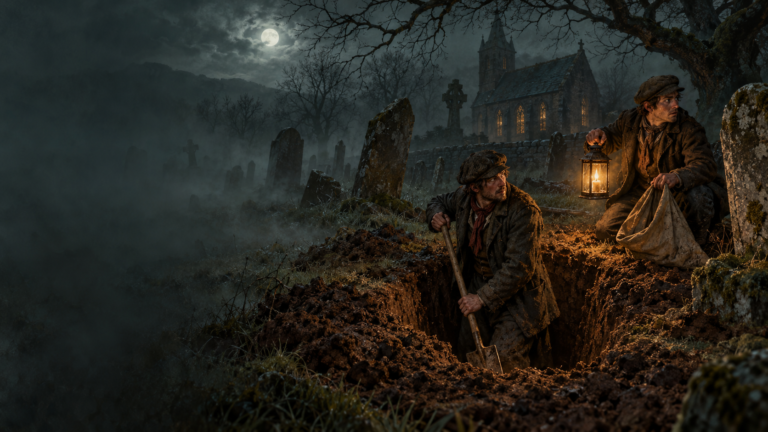
New York had one medical school, at Columbia College, plus New York Hospital, where doctors also taught anatomy. Like everywhere else at the time, they needed bodies to dissect, and there was no legal way to get enough. So medical students did what students all over the world were doing: they dug them up. (We covered how that worked in our post on body snatchers.)
At first, they mostly raided the paupers’ field, where the city’s poorest were buried, just outside the city and close to the hospital. Grave robbing worked best in winter, when bodies decayed more slowly, and the winter of 1787–88 was busy.
Then the students got bolder. Bodies began disappearing from respectable churchyards too, including Trinity Church. Local newspapers ran angry letters about stolen corpses and bones being sold. The whole city was paying attention now, and the anger had nowhere to go.
It just needed a spark.
The Arm in the Window: How the Doctors’ Riot Started

On April 13, 1788, a group of boys was playing outside New York Hospital. Upstairs, a medical student named John Hicks was working in the anatomy room, dissecting a human arm.
The boys were noisy. Hicks was apparently not in the mood. So, according to the most popular version of the story, he leaned out of the window, waved the arm at them, and shouted something like: this is your mother’s arm, I just dug it up.
It was meant as a sick joke. It landed as a catastrophe.
One of those boys had actually lost his mother not long before. Terrified, he ran home and told his father. The father went straight to his wife’s grave and dug it up.
The coffin was empty.
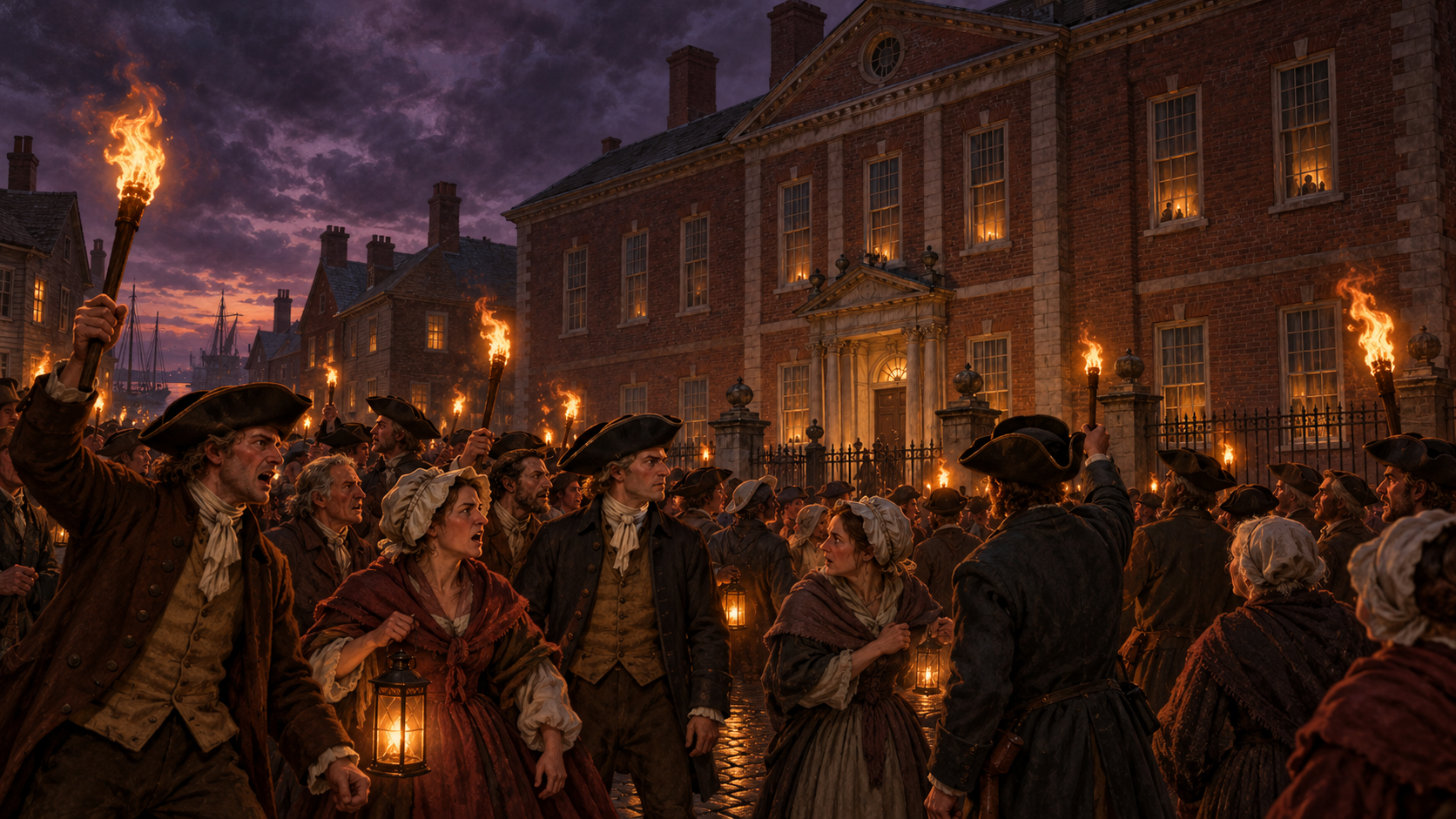
Whether that arm really was his wife’s, nobody will ever know. It didn’t matter. The father gathered his friends and neighbours, the story spread through the streets at the speed of gossip, and within hours a crowd was marching on the hospital.
Day One: The Mob Storms the Hospital
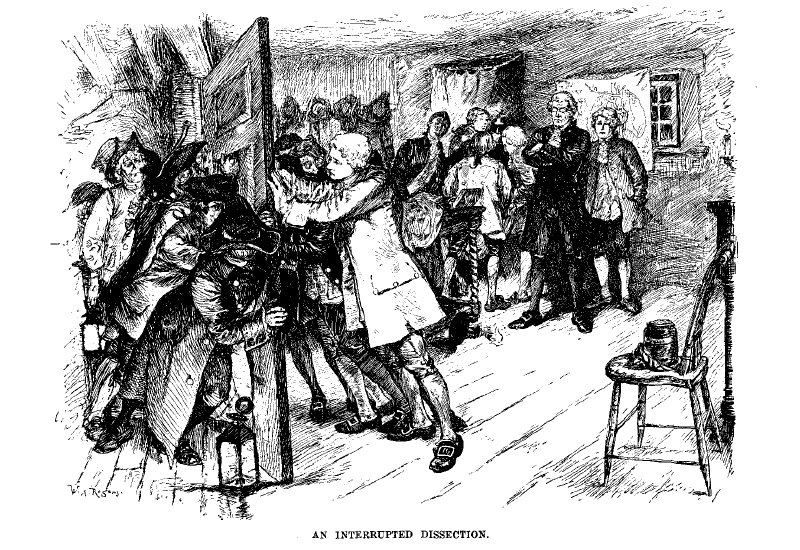
The crowd broke into New York Hospital and headed for the anatomy room. What they found there confirmed their worst fears: human remains in various stages of dissection.
Hicks and most of the students had already fled. The doctors who couldn’t get out in time improvised. According to accounts from the period, some slipped out of windows, some hid behind barrels, some climbed up chimneys, and at least one hid under a feather bed.
The mob carried the remains outside and displayed them to the growing crowd. Then they gathered up every specimen they could find and destroyed them. They also caught the doctors who hadn’t escaped, including Wright Post, assistant to the anatomy teacher Dr Richard Bayley, and dragged them into the street.
By now around 2,000 people had gathered. Things could have turned deadly right there. Instead, the mayor, James Duane, stepped in and had the captured doctors taken to the city jail. Not as punishment, but for their own protection.
It seemed to work. As night fell, the crowd began to thin out.
It didn’t last.
Day Two: The Siege of the Jail
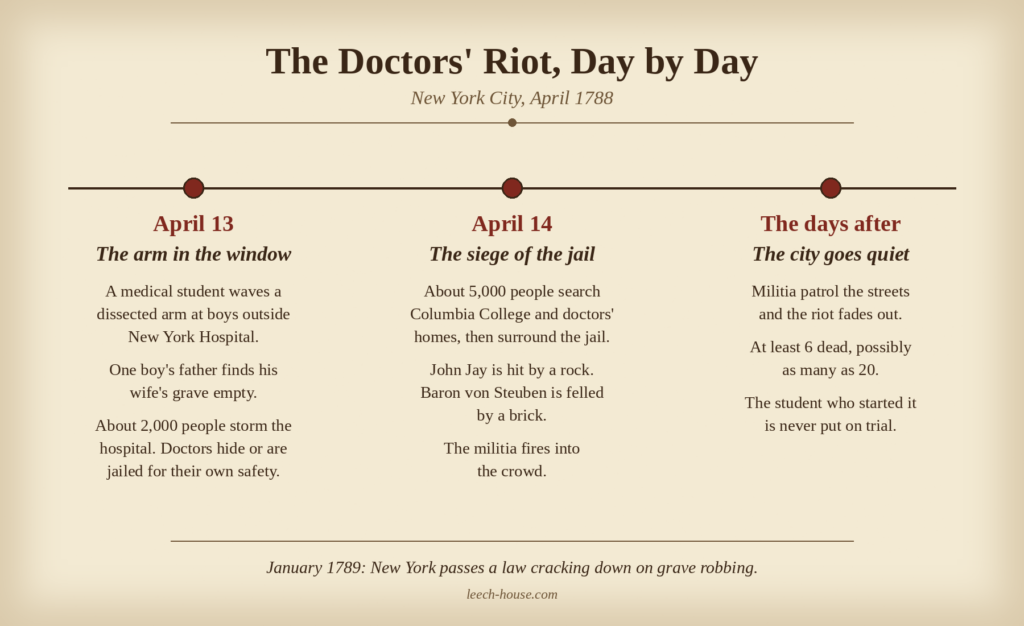
The next morning, the crowd came back bigger. Much bigger. Estimates put it at around 5,000 people, in a city of roughly 30,000.
First they marched on Columbia College to search the medical school for bodies. Alexander Hamilton, then a young lawyer who had studied at the college, stood on the steps and begged them to go home. They pushed right past him. They found nothing.
So they went house to house, searching the homes of well-known doctors. Then they turned back toward the place they knew the doctors were: the jail.
The crowd surrounded the building, throwing rocks and bricks and chanting for the doctors to be brought out. Inside, the very men they wanted were waiting it out behind the walls.
Governor George Clinton called out the militia. And this is where the famous names start getting hurt.
John Jay, a future first Chief Justice of the United States, came to help calm the crowd. A rock hit him in the head. His wife later wrote that it left two large holes in his forehead.
Baron von Steuben, the Prussian general who had drilled George Washington’s army into shape, reportedly urged the governor not to let the soldiers fire on the crowd. Then a brick knocked him to the ground. According to the popular telling, the dazed general promptly changed his mind.
The militia fired into the crowd.
When the smoke cleared, people were dead. At least six were killed outright, both rioters and militiamen, and some estimates put the final death toll as high as 20.
The doctors inside the jail, the only people in the city trained to treat gunshot wounds, were too afraid to come out.
What Happened to the Doctors?
You’d expect the man who started it all to pay for it. He didn’t. John Hicks was never put on trial. A few medical students did face charges, but the riot’s most famous troublemaker walked away.
His teacher, Dr Richard Bayley, had the strangest afterlife of anyone in this story. The mob had hunted him through the city. Yet Bayley stayed in New York and went on to become the Port of New York’s first health officer, devoting the rest of his career to fighting epidemics. He died in 1801 after catching yellow fever while caring for sick immigrants at the city’s quarantine station.
And his daughter? Elizabeth Ann Seton, who in 1975 became the first person born in the United States to be made a Catholic saint.
So the doctor whose students sparked one of the deadliest riots of the era ended up with a saint for a daughter and a reputation as a public health pioneer. History is strange like that.
What Changed After the Doctors’ Riot?
The riot didn’t end body snatching in America. Not even close. But it did force New York to act.
In January 1789, less than a year later, the New York State Legislature passed a law cracking down on grave robbing. Getting caught digging up a body for dissection could now mean fines, prison, the pillory or a public whipping. Doctors could legally dissect only the bodies of executed criminals. New York also brought in some of the earliest rules in the country for who could call themselves a doctor, requiring proper training and an exam.
The riot wasn’t a one-off, either. Historians have counted at least 17 anatomy riots in American cities between 1765 and 1854. Wherever there was a medical school, there were people who suspected, often correctly, that their dead weren’t staying put.
New York had learned the hard way that ignoring people’s fears about their dead came with a price.
Doctors’ Riot FAQ
What was the Doctors’ Riot?
A riot in New York City in April 1788, sparked by anger over medical students digging up graves for bodies to dissect.
When did the Doctors’ Riot happen?
It began on April 13, 1788, and lasted about three days.
What started the Doctors’ Riot?
According to the most popular account, medical student John Hicks waved a dissected arm out of a hospital window at some boys and told one of them it was his mother’s. The boy’s father found her grave empty.
How many people died in the Doctors’ Riot?
At least six, and possibly as many as 20.
Was anyone famous involved?
Yes. John Jay was hit in the head by a rock, Baron von Steuben was knocked down by a brick, and Alexander Hamilton tried to talk the crowd out of searching Columbia College.
Did the riot stop grave robbing?
Not entirely. New York passed a law in 1789 cracking down on it, but body snatching continued across the US for decades.
One bad joke, one empty coffin, and a city that had been ignoring the warning signs for months. The Doctors’ Riot is a reminder that you can only push people’s grief so far.