Body Snatchers: Why Doctors Paid People to Dig Up the Dead
Imagine burying someone you love, then going back the next morning to find the grave disturbed and the coffin empty.
For people in 1700s and 1800s Britain, this wasn’t a horror story. It was a real fear, and a common one. Families hired guards. Churches built watchtowers. Some people bolted iron cages over their graves.
The thieves weren’t after jewellery. They were after the body itself. And the people paying for those bodies? Doctors.
Welcome to the world of the body snatchers, where medicine, money and the freshly dead all met in the middle of the night.
Why Did Doctors Need Dead Bodies?
To become a good surgeon, you need to know what’s inside a person. And the only way to really learn that is to take one apart.
By the 1700s, medical schools in Britain were booming, especially in Edinburgh and London. Surgeons were starting to prove just how valuable anatomy was. Every student needed to dissect, and every dissection needed a body.
There was just one problem: almost no bodies were legally available.
In 1752, Britain passed the Murder Act. It said that the bodies of executed murderers could be handed over for dissection, as an extra punishment on top of the hanging. Being cut up in public was considered a fate worse than death.
But there weren’t nearly enough executed murderers to go around. Demand kept rising, and supply couldn’t keep up.
So the market did what markets do. Someone found another supply.
Who Were the Resurrection Men?
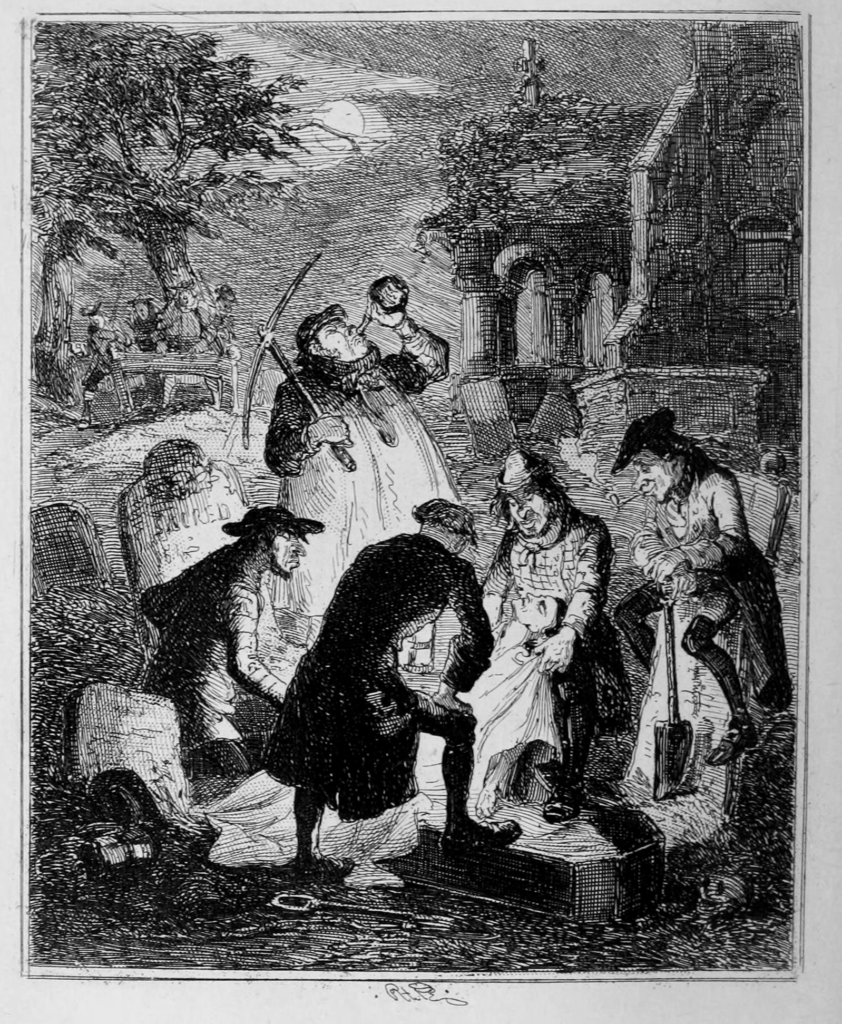
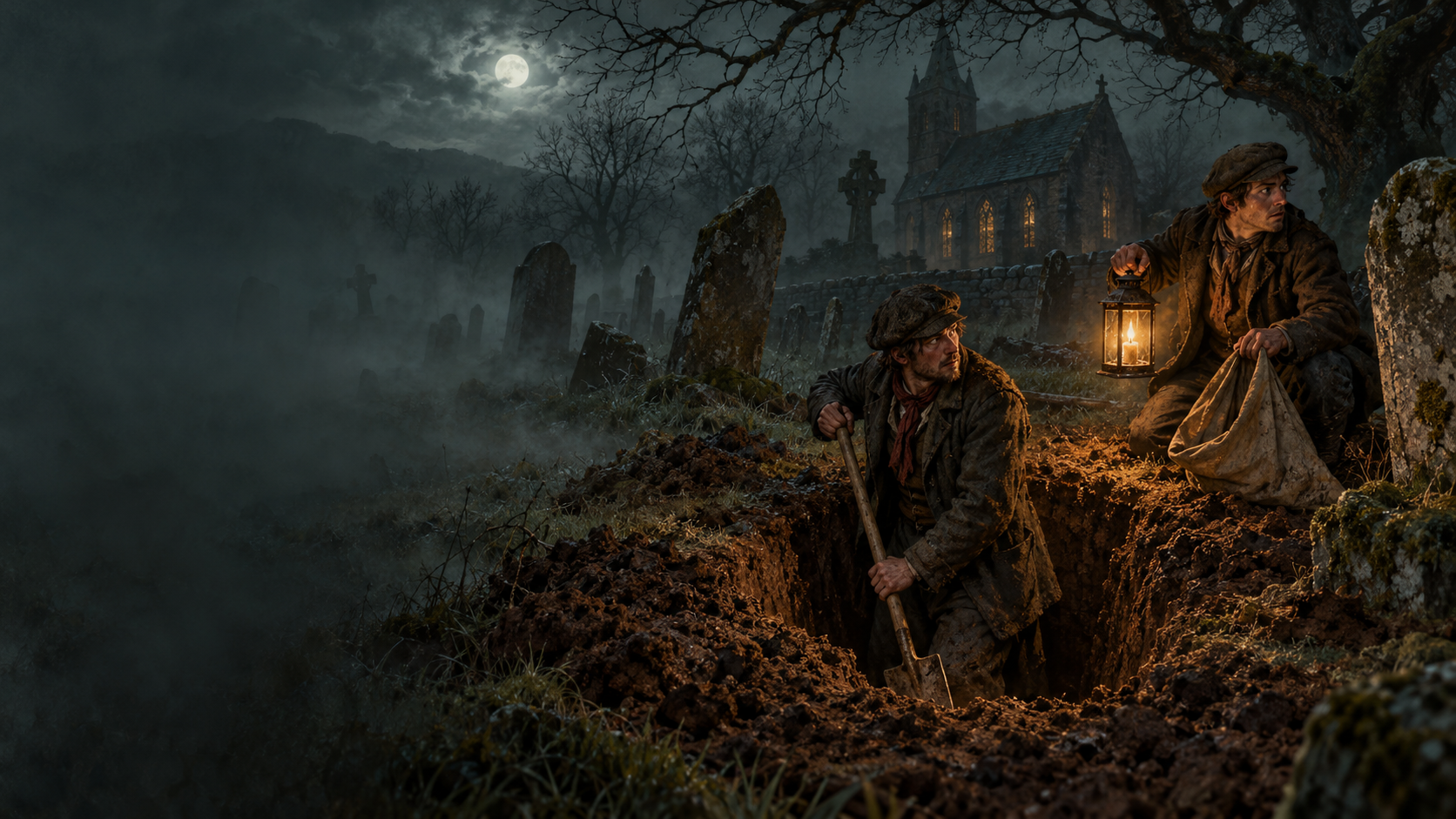
The men who dug up bodies for doctors were called resurrection men, or resurrectionists. It’s a darkly funny name. They raised the dead, just not in the way the Bible meant.
They had other nicknames too. Some called them “sack-’em-up men,” because of the big sacks they carried the bodies off in. Others called them “night doctors.”
Most were working-class men in gangs who knew the trade well. They watched funerals, bribed gravediggers and sextons, and kept track of who had been buried where. Timing mattered. A body was only useful for a short window before it started to decay, so they struck fast, often the same night as the burial.
And the doctors buying from them rarely asked questions. A body was a body.
Some bodies were worth far more than others. In 1783, Charles Byrne, a man famous for being about 7 feet 7 inches tall, died in London. He was so afraid of ending up on a dissecting table that he begged to be buried at sea. It didn’t work. The men hired to guard his body reportedly sold it to the surgeon John Hunter for around £500, a fortune at the time. Byrne’s skeleton stayed on display in a London museum for over two centuries.
How Did Body Snatchers Steal a Body?
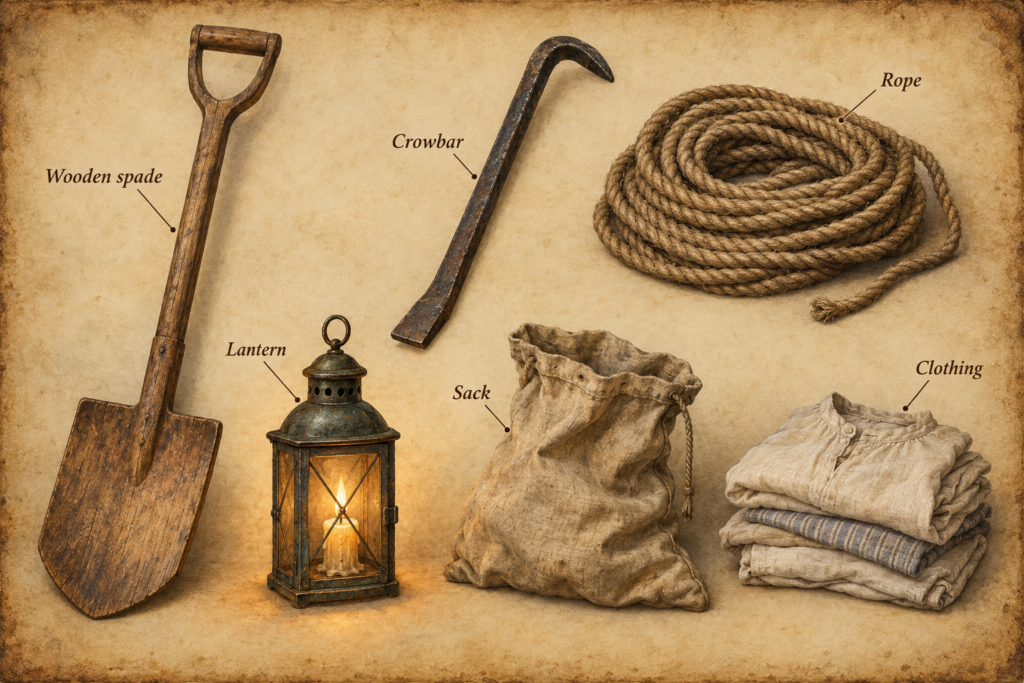
If you’re picturing men digging up an entire grave, think smaller. Resurrection men were efficient.
Here’s how a typical job worked:
- Dig only at the head end. Instead of uncovering the whole coffin, they dug a narrow hole down to where the head was. Less digging, less time, less mess to hide.
- Keep it quiet. Some used wooden spades, which made less noise than iron ones scraping on stones.
- Crack the lid. Once they hit the coffin, they broke open the top end. The weight of the soil on the rest of the lid helped it snap.
- Pull the body out. A rope looped under the arms or around the neck, and up it came.
- Strip it. The burial clothes went back into the coffin. (There was a very good legal reason for that. More on that below.)
- Sack it and go. Into the sack, onto the cart, and off to the anatomy school before sunrise.
- Tidy up. Fill the hole back in and try to leave the grave looking untouched.
An experienced team could reportedly do all this in under an hour. Grieving families often never knew their loved one was gone.
The Loophole: Stealing a Body Wasn’t Theft
Here’s the strangest part of the whole story. In Britain at the time, stealing a dead body wasn’t technically theft.
Why? Because under the law, a corpse didn’t belong to anyone. You can’t steal something nobody owns. Disturbing a grave could still land you a fine or a short jail term, but it was treated as a minor offence.
But the stuff buried with the body was a different matter. The shroud, the clothes, a ring, the coffin itself: all of that was property. Take any of it, and you could be charged with theft, which carried much harsher penalties.
So resurrection men became very careful about one thing. They took the body, and only the body. Everything else went neatly back in the grave.
It’s one of the most morbid technicalities in legal history. You could dig up someone’s grandmother and sell her to a surgeon, but if you kept her nightgown, now you were in real trouble.
Burke and Hare: When Body Snatching Turned to Murder
Digging up bodies was hard, dirty work. In 1828, two men in Edinburgh found a shortcut.
William Burke and William Hare were Irish labourers. Hare’s wife ran a cheap lodging house. When one of the lodgers died owing rent, the two men didn’t bury him. They sold his body to Dr Robert Knox, a popular anatomy lecturer, for just over £7.
That was more money than they’d see in months of honest work. And it gave them an idea.
Over the next ten months, Burke and Hare murdered 16 people. Their victims were mostly poor, sick or alone: lodgers, travellers, people few would miss. Typically, the men got their victims drunk, then smothered them, which left almost no marks. The bodies went straight to Knox’s dissecting rooms, sometimes still warm. Knox paid up to £10 each and never asked where they came from.
The murders unravelled when lodgers found a victim’s body hidden in the house and went to the police. Hare turned King’s evidence and testified against his partner in exchange for immunity. Burke was convicted and hanged in January 1829, in front of a crowd said to number around 25,000.
Then came the twist that writes itself. Burke’s body was publicly dissected, just like his victims. His skeleton is still on display at the University of Edinburgh’s Anatomical Museum. And a small pocketbook said to be bound in his skin sits in Surgeons’ Hall Museums in Edinburgh.
Hare walked free and vanished. Knox was never charged, though his reputation never recovered. Edinburgh even came up with a rhyme about the three of them:
Burke’s the butcher, Hare’s the thief, Knox the boy that buys the beef.
Burke also left behind a word. To “burke” someone came to mean to smother them, or to quietly hush something up.
How People Protected Their Dead From Body Snatchers
If you were grieving in the early 1800s, you also had to worry about security. People got creative.
- Grave watchers. Families or hired men sat by a fresh grave for several nights until the body was too decayed to sell. Some churchyards built watchtowers and watch houses just for this. The catch: some watchmen were bribed by the very gangs they were meant to stop.
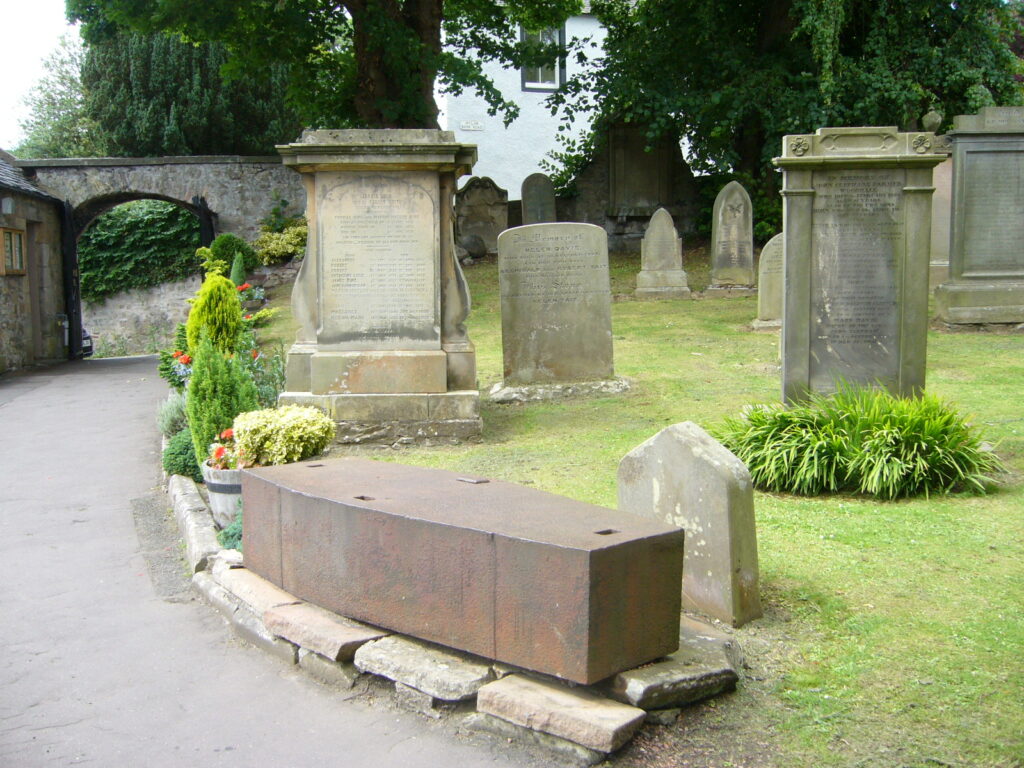
- Mortsafes. Heavy iron cages, bolted over the grave or even around the coffin. They were too heavy for a small gang to lift, so the body stayed put until it was no longer useful to anyone. Then the cage was dug up and rented out to the next family. You can still see mortsafes in Edinburgh kirkyards today.
- Iron coffins. Wealthier families sometimes skipped the cage and buried their dead in coffins made of iron.
- Deep graves and heavy slabs. Bury the body deeper, or put a massive stone on top, and you make the job slower and noisier.
- The coffin torpedo. In 1878, an Ohio inventor named Philip K. Clover patented a small gun that fit inside a coffin. Hidden wires connected it to the body. If anyone tried to pull the corpse out, it fired a blast of lead balls at the thief. Clover’s patent noted that it didn’t need much weatherproofing, since by the time it stopped working, the body would be of no use to robbers anyway.
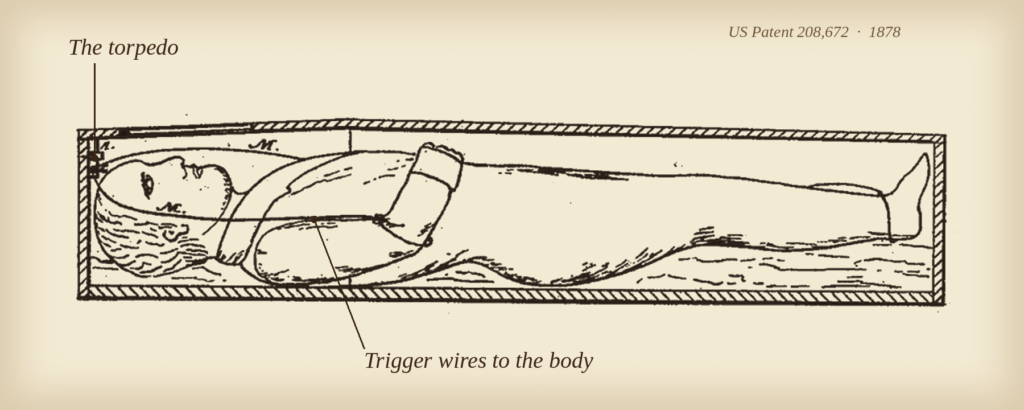
Did coffin torpedoes ever actually blow anyone up? Historians are doubtful. There are a few dramatic newspaper stories from the time, but little hard evidence that many were ever buried. Still, just the rumour of a booby-trapped grave was probably enough to make some resurrection men think twice.
Body Snatching in America
Britain wasn’t the only place with a body shortage. American medical schools had the same problem, and the same solution.
The trade was not equal-opportunity. In the US, body snatchers overwhelmingly targeted the graves of the poor and of Black Americans, whose burial grounds were often less protected and whose families had less power to fight back. It’s one of the uglier truths of early American medicine.
Public anger sometimes boiled over. In 1788, rumours of medical students digging up graves sparked a deadly riot in New York City, now known as the Doctors’ Riot. It allegedly started with a medical student waving a severed arm out of a hospital window at a group of boys. That one deserves its own post, and it’s coming soon.
And it didn’t only happen to the poor. In 1878, John Scott Harrison, a former congressman who was the son of one US president and the father of another, died in Ohio. Shortly after his funeral, his family went to the Ohio Medical College in Cincinnati searching for a different stolen body, a family friend’s. Instead, they found Harrison himself, hidden at the college and waiting for the dissecting table. The scandal made national headlines, and that same year Philip Clover patented his coffin torpedo.
Bonus weirdness: in 1998, workers renovating Benjamin Franklin’s old London home found a pit in the basement holding over 1,200 pieces of human and animal bone. Franklin wasn’t a serial killer. His friend William Hewson had run a secret anatomy school out of the house in the 1770s, and buried what was left rather than risk being caught moving it.
How Body Snatching Ended: The Anatomy Act of 1832
In Britain, the end came after one more scandal. In 1831, a gang in London nicknamed the “London Burkers” copied Burke and Hare and murdered a 14-year-old boy to sell his body. Public outrage finally pushed Parliament to act.
The Anatomy Act of 1832 gave doctors a legal supply of bodies. Instead of executed murderers, they could now dissect the “unclaimed” dead from workhouses, hospitals and prisons, people whose families couldn’t afford to bury them.
It worked. With a steady legal supply, the price of a stolen corpse collapsed, and the resurrection men were out of business within a few years.
But it came at a cost. The burden simply shifted onto the poor. Dying penniless in a workhouse now meant your body could end up on a dissecting table. For generations afterward, poor families scrimped and saved for a proper funeral, terrified of that fate.
Today, medical schools rely on people who choose to donate their bodies to science. It took a few centuries, a lot of stolen corpses and 16 murders to get there.
Body Snatchers FAQ
What were body snatchers?
People who dug up freshly buried bodies and sold them to medical schools and anatomists for dissection, mostly in the 1700s and 1800s.
Why were they called resurrection men?
Because they “raised” the dead from their graves. A dark joke on the religious idea of resurrection.
Was body snatching illegal?
Oddly, stealing a body wasn’t theft, because a corpse legally belonged to no one. Disturbing a grave was a minor offence, but taking the clothes or belongings buried with the body was treated as theft, so body snatchers left those behind.
How much was a body worth?
It varied, but Edinburgh anatomist Robert Knox paid Burke and Hare between about £7 and £10 per body, months of wages for a labourer.
Were Burke and Hare grave robbers?
Not really. They skipped the digging and murdered 16 people to sell their bodies instead.
What is a mortsafe?
An iron cage placed over a grave to stop body snatchers from reaching the coffin.
When did body snatching stop?
In Britain, the Anatomy Act of 1832 gave doctors a legal supply of bodies and put the resurrection men out of business.
So the next time you walk past an old churchyard and spot an iron cage over a grave, now you know. It isn’t there to keep the dead in. It’s there to keep the living out.
Further Reading
- Resurrectionists in the United Kingdom, Wikipedia
- Burke and Hare murders, Wikipedia
- Resurrection Men: The scourge of the body snatchers, History UK
- The History of Burke and Hare and of the Resurrectionist Times (1884), The Public Domain Review
- Burke and Hare and Knox, JSTOR Daily
- Patent model: Improvement in Coffin-Torpedoes, Hagley Museum
- Coffin torpedoes, Atlas Obscura
- Remembering William Hewson: the bones in our basement, Benjamin Franklin House