

25 Medical Words That Sound Made Up—but Weren’t
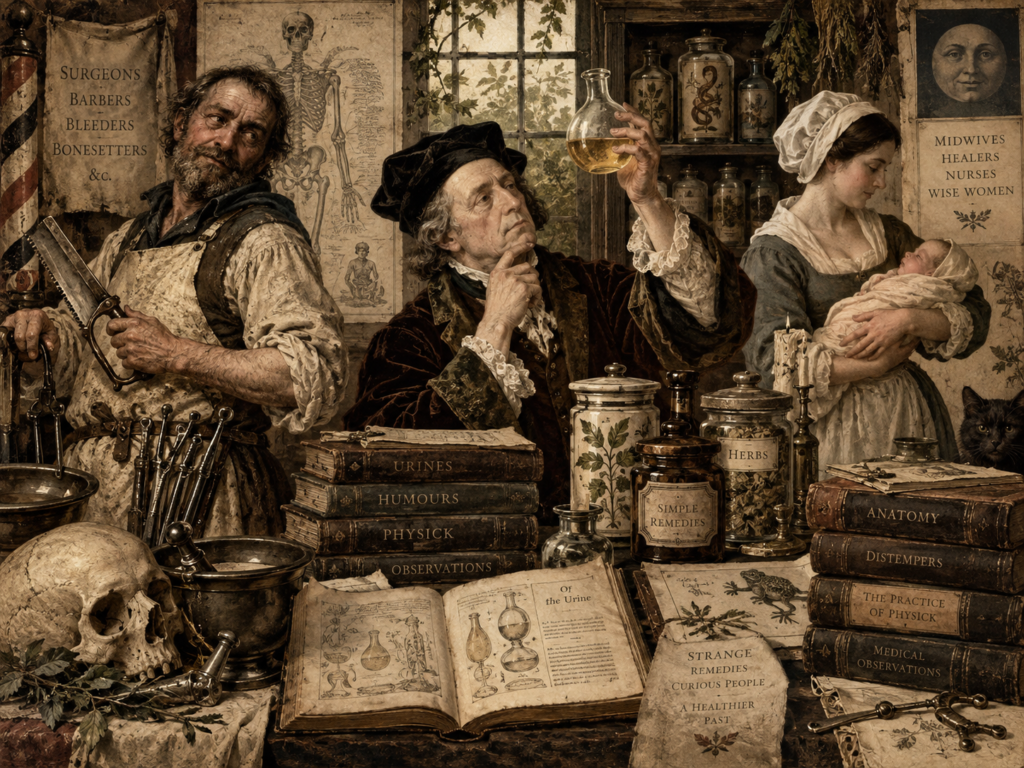
Medical language has never exactly been known for being friendly.
Today we have words like:
gastroesophageal reflux disease
thrombocytopenia
electroencephalography
Very respectable.
Very scientific.
Very capable of making a patient pretend they understood what the doctor just said.
But older medicine had its own vocabulary.
And sometimes it was much better.
There were piss prophets.
Sawbones.
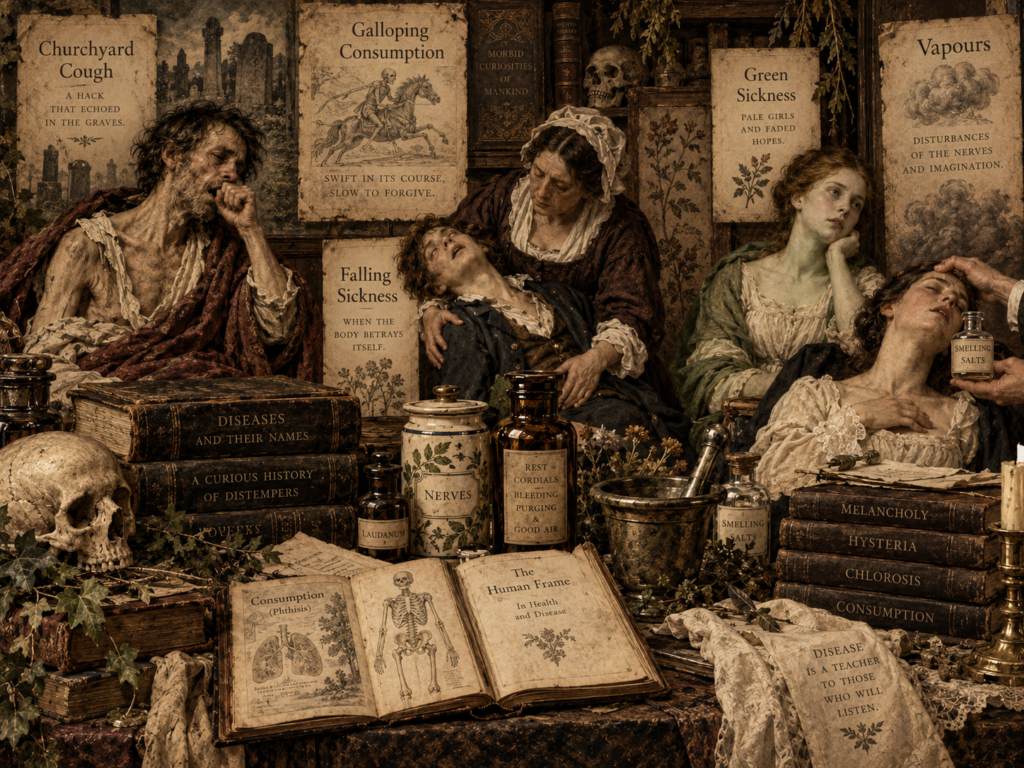
Churchyard coughs.
Agony wagons.
Rabbit catchers.
And something called a back door trot, which is precisely as elegant as it sounds.
Here are 25 old medical terms that sound fictional—
but were once used seriously enough to make it into dictionaries, medical writing, slang, or historical records.
1. Piss Prophet
A piss prophet was a physician who diagnosed illness mainly—or entirely—by examining a patient’s urine.
Urine inspection, or uroscopy, was once a major diagnostic tool.
Colour, sediment, clarity, smell, and other features could all be interpreted as clues to disease.
Some practitioners became so associated with the practice that apparently:
doctor + urine = piss prophet.
Subtlety was not invited.
2. Sawbones
A sawbones was a surgeon.
The term makes considerably more sense when you remember that historical surgery involved a great deal more literal sawing than most people would prefer to imagine.
Particularly with amputations.
Nothing says professional confidence quite like:
“The sawbones will see you now.”
3. Quacksalver
Before we had the shortened word quack, there was quacksalver.
It referred to an unqualified medical practitioner who often sold or prescribed remedies of questionable value.
Your terminology source dates the word to at least the sixteenth century.
Eventually humanity decided even fraud needed efficiency and shortened it to:
quack.
4. Agony Wagon
An agony wagon was a military ambulance during the First World War.
Not particularly reassuring branding.
But certainly honest.
5. Churchyard Cough
A churchyard cough was a cough associated with severe or fatal lung disease, especially consumption or tuberculosis.
Basically:
a cough bad enough that people were already mentally locating the cemetery.
Cheerful.
6. Falling Sickness
Falling sickness was an old name for epilepsy.
The term referred to the dramatic collapse associated with seizures.
Epilepsy also accumulated spiritual and supernatural interpretations over centuries because seizures could involve loss of consciousness, strange movements, visions, or altered behaviour.
The disease was mysterious.
The name was extremely literal.
7. King’s Evil
King’s evil referred to scrofula, historically associated with tuberculosis of the lymph nodes.
For centuries in England and France, people believed the sovereign could cure it by touching the afflicted person.
The practice became known as the royal touch.
We already brushed against this one in the corpse-medicine article.
Because apparently historical medicine loved nothing more than asking:
“Have you tried getting touched by someone important?”
8. Galloping Consumption
Consumption was a common historical name for tuberculosis.
Galloping consumption described a particularly rapid course of the disease in which a person deteriorated and died within weeks or months.
The word galloping is disturbingly efficient.
Disease, but make it hurry.
9. Vapours
The vapours referred to a vague collection of symptoms involving low spirits, faintness, nervous complaints, hypochondria, or hysteria.
Women were often said to be especially susceptible.
Because naturally, if medicine did not understand a woman’s symptoms, there was always the option of blaming mysterious internal fumes.
10. Back Door Trot
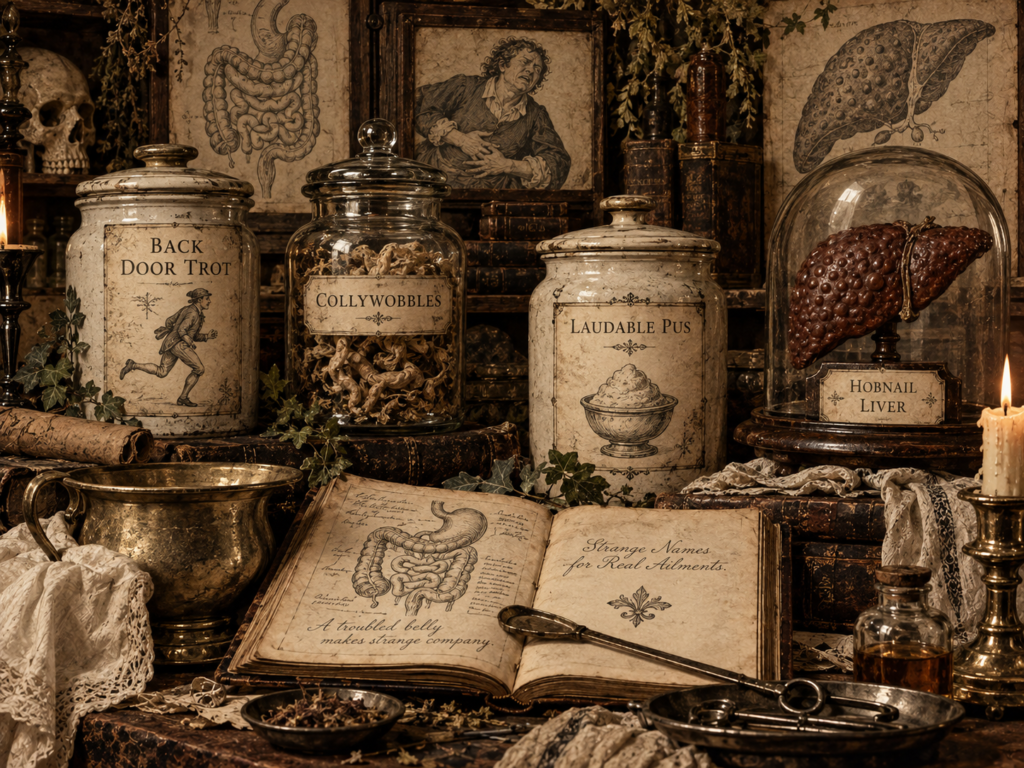
This was an old slang term for:
diarrhoea.
And honestly?
English peaked here.
11. Collywobbles
Another digestive classic.
Collywobbles referred to stomach upset, abdominal discomfort, and sometimes diarrhoea.
Unlike many obsolete medical terms, this one deserves a comeback.
Imagine charting:
Patient reports severe collywobbles since breakfast.
Beautiful.
12. Green Sickness
Green sickness was historically associated with anemia in adolescent girls or unmarried women.
It was also called things like chlorosis or virgin’s disease, reflecting older beliefs that female illness could somehow arise from celibacy or reproductive status.
Which is an excellent reminder that medicine has spent a truly heroic amount of time blaming women for having bodies.
13. Hobnail Liver
A hobnail liver described a diseased liver whose scarred surface resembled the large-headed nails once used in boots and shoes.
The appearance is associated historically with advanced cirrhosis.
Gruesome.
But as anatomical descriptions go?
Surprisingly effective.
14. Laudable Pus
Yes.
Laudable pus.
Historically, some physicians believed the presence of certain kinds of pus in a wound could indicate proper healing.
The adjective laudable means worthy of praise.
So somewhere in medical history, someone looked at pus and essentially said:
Excellent work.
15. Horse-Leech
A horse-leech could mean a veterinary surgeon.
The older word leech itself could mean a physician or healer, completely separate from the bloodsucking animal meaning.
Which brings us to something particularly relevant around here.
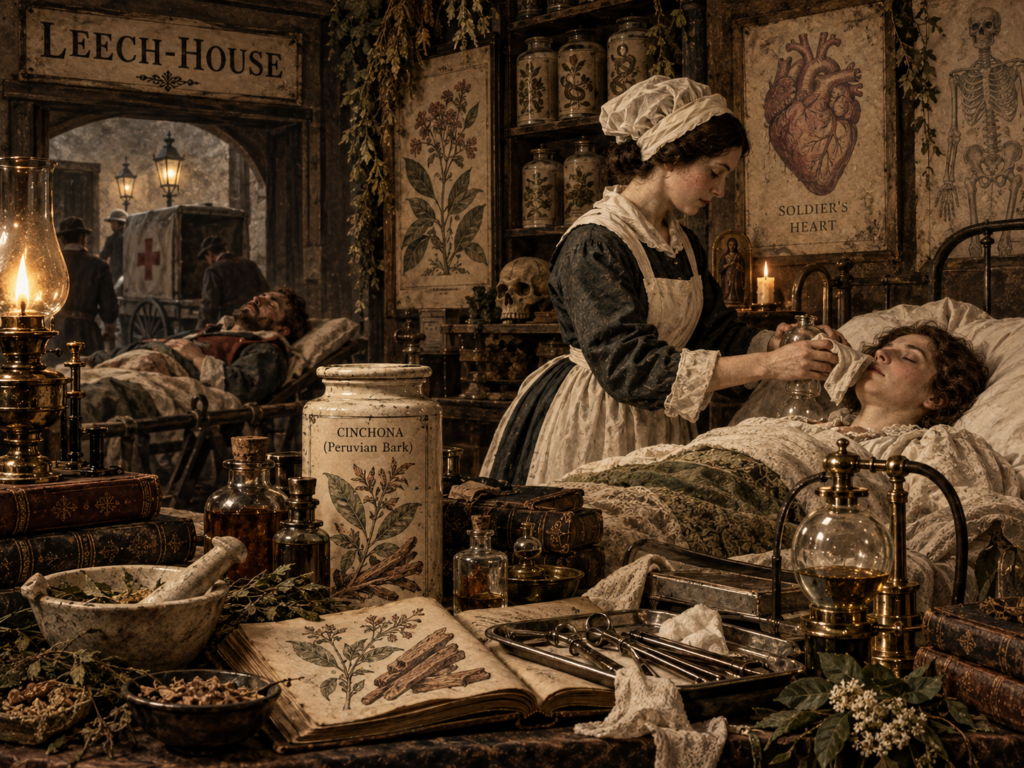
16. Leech-House
A leech-house was an old word for:
a hospital.
Your terminology source traces it back to Old English usage.
And yes.
That is exactly where the name Leech House gets especially satisfying.
Because it does not only evoke medicinal leeches.
It can literally mean:
the healer’s house.
Or a place of medicine.
Which is considerably more respectable than this website deserves.
17. Rabbit Catcher
A rabbit catcher was slang for a midwife.
Why?
Historical slang is rarely courteous enough to leave documentation explaining itself.
But the image is certainly memorable.
18. Nightingale Nurse
A Nightingale nurse referred to a nurse associated with the professional nursing tradition established by Florence Nightingale.
Compared with sawbones and piss prophet, this one almost sounds dignified.
We cannot have everything.
19. Nimgimmer
A nimgimmer or nimglimmer could mean a physician.
In some nineteenth-century American usage, it could more specifically refer to someone treating venereal disease.
It sounds less like a doctor and more like something living under a bridge.
Which only improves it.
20. Nostrum
A nostrum was a medicine, especially a secret or proprietary remedy, often associated with quack medicine.
The seller usually knew exactly what was in it.
The customer frequently did not.
Confidence was apparently the active ingredient.
21. Pest Hospital
A pest hospital was an isolation hospital used for people with infectious diseases such as smallpox.
The word pest here referred to pestilence or epidemic disease.
Not exactly the kind of hospital name likely to improve patient satisfaction scores.
22. Peruvian Bark
Peruvian bark referred to cinchona bark.
It became enormously important because cinchona contains compounds from which quinine was derived and was historically used against malaria.
It was also known as Jesuit’s bark or Jesuit’s powder.
One plant.
Several names.
A very long medical career.
23. Soldier’s Heart
Soldier’s heart described a cluster of symptoms including palpitations, breathlessness, fatigue, anxiety, and distress reported among soldiers.
The terminology and interpretations changed over time as medicine struggled to understand the physical and psychological effects of war.
Later wars would generate other terms—
including shell shock.
Language often changes before understanding catches up.
24. Twilight Sleep
Twilight sleep referred to the use of drugs such as morphine and scopolamine to produce sedation and amnesia during childbirth.
The term comes from the German Dämmerschlaf.
It sounds peaceful.
Historical obstetrics frequently was not.
25. Water Scriger
A water scriger was another term for a physician who diagnosed disease by inspecting urine.
So yes—
we began with piss prophet and ended with water scriger.
Apparently uroscopy generated its own entire branding department.
Medicine Has Always Had a Language Problem
Old medical terminology can sound ridiculous now.
But words preserve the way people understood disease.
Falling sickness describes what observers saw.
Churchyard cough captures the fear surrounding tuberculosis.
King’s evil preserves the belief that royalty carried healing power.
Laudable pus reflects an older interpretation of wound healing.
Piss prophet tells us how important urine inspection once became.
And leech-house remembers an era when the very word leech could mean healer.
These terms are funny.
But they are also tiny historical fossils.
Each one preserves a fragment of how someone once looked at illness and tried to give it a name.
Sometimes scientifically.
Sometimes poetically.
And sometimes with absolutely no restraint whatsoever.
Back door trot.
Never forget.
Sources & Further Reading
Thornber — Glossary of Medical Terms Used in the 18th and 19th Centuries
For obsolete disease names and historical medical terminology.
Open Thornber’s Medical Glossary
Francis Grose / Historical Slang Glossary
For terms including piss prophet, nimgimmer, rabbit catcher, water scriger, and quack-salver.
Open the Historical Occupations & Slang Glossary
Farmer & Henley — Slang and Its Analogues Past and Present
For older slang such as back-door trot and collywobbles. A digitized copy is available through Wikimedia Commons.