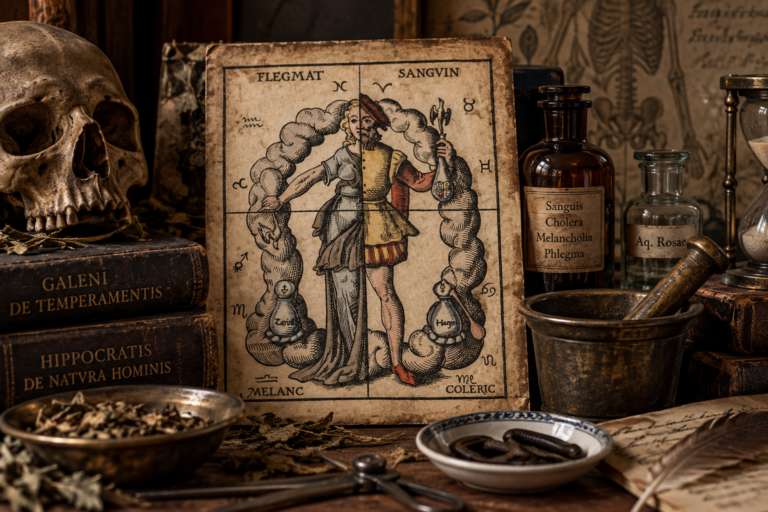
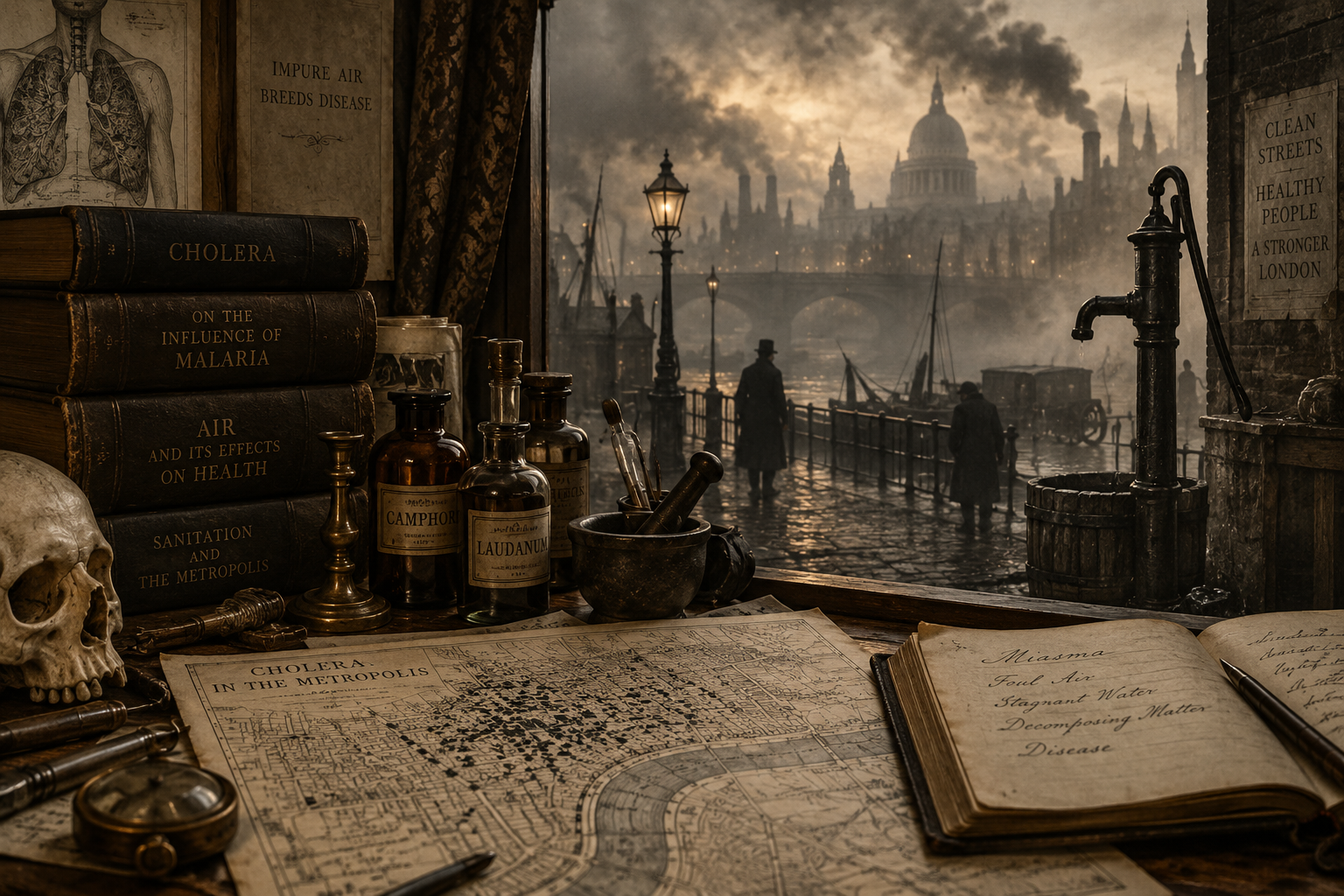
Before Germ Theory: When Doctors Thought Bad Air Made You Sick
If a city smells like rot, sewage, smoke, and death, it is not especially difficult to believe the air itself is trying to kill you.
For centuries, many physicians, officials, and ordinary people believed exactly that.
Disease, they thought, spread through miasma—foul, corrupt, contaminated air rising from filth, swamps, decay, overcrowded streets, and poorly ventilated spaces.
In other words:
If something smelled terrible, it was probably dangerous.
To be fair, that was not the worst conclusion humanity has ever reached.
It just was not the whole story.
Before microbes became visible and germ theory transformed medicine, miasma theory offered a powerful explanation for why people got sick, why epidemics struck certain places, and why some neighborhoods seemed far deadlier than others.
It influenced medical thought, urban planning, public health, and sanitation for generations.
It was wrong.
But it was wrong in a way that still managed to shape the modern world.
What Was Miasma Theory?
The word miasma comes from a Greek term referring to pollution or defilement.
In medical history, it came to mean noxious, disease-causing air.
The basic idea was simple:
Disease arose from breathing in air corrupted by rotting organic matter, human waste, stagnant water, overcrowding, filth, or decaying bodies.
Bad smells were not just unpleasant.
They were treated as clues.
Or even as the disease itself in atmospheric form.
Miasma theory was not one neatly packaged doctrine invented by one person and then obeyed by everyone forever. Like many old medical beliefs, it evolved over time and absorbed other ideas along the way.
But as a general framework, it became enormously influential.
If the air was foul, the risk was high.
If a place was clean, elevated, airy, and well ventilated, it was healthier.
That logic shaped everything from household advice to city reforms.
Why the Theory Made Sense
This is one of those historical ideas that is easier to mock than to understand.
And yet, if we are being honest, miasma theory made a disturbing amount of observational sense.
People living in filthy, overcrowded places really did get sick more often.
Areas with open sewage, stagnant water, rotting waste, and poor drainage really were associated with outbreaks.
Places that smelled terrible were often unhealthy.
Not because the smell itself caused disease—
but because the smell often came from the same conditions that allowed disease to spread.
So people noticed real patterns.
They just explained them incorrectly.
That is what makes miasma theory historically interesting.
It was not nonsense invented in total defiance of experience.
It was a mistaken interpretation of genuine environmental danger.
A Much Older Way of Thinking
Long before germ theory, ancient medical writers were already connecting environment and health.
One of the classic examples is the Hippocratic text Airs, Waters, Places, which discusses how climate, winds, waters, and surroundings affect the health of populations.
That is not exactly the same thing as later miasma theory, but it helped establish a long tradition of linking disease to environment.
For centuries, medicine kept asking:
- What kind of place is this?
- What kind of air do people breathe here?
- What kind of water do they use?
- What kind of climate shapes their bodies?
Those are not foolish questions.
They just eventually needed a better biological explanation.
Plague, Filth, and Fear
Miasma theory became especially persuasive during epidemics.
When plague struck, people often noticed foul air, overcrowding, unburied bodies, rotting waste, and general urban misery all at once.
It was easy to believe that pestilence traveled as a poisonous atmospheric corruption.
This helps explain why responses to epidemic disease often focused on things like:
- burning incense or herbs
- carrying pomanders
- improving ventilation
- avoiding marshes or crowded spaces
- cleaning streets
- removing filth
- isolating places thought to have dangerous air
Some of those responses did very little.
Some were symbolic.
Some actually helped—not because they purified a supernatural poison cloud, but because they reduced contact with contaminated environments or sick people.
History loves this kind of irony.
Sometimes people got partial results using the wrong explanation.
The Smell Test of History
Miasma theory also helps explain why smell mattered so much in older medicine.
A foul odor did not just offend the senses.
It suggested corruption.
Danger.
Decay.
Disease.
That old instinct lingered for a very long time.
Even in the nineteenth century, reformers described slums, sewers, graveyards, hospitals, and industrial neighborhoods in language full of choking vapors, poisonous exhalations, and unwholesome atmosphere.
Disease was imagined not merely as something transmitted from person to person, but as something generated by an unhealthy environment itself.
And honestly, some environments really were horrifying enough to sell the theory on sight.
Or smell.
Cholera and the Problem With Bad Air
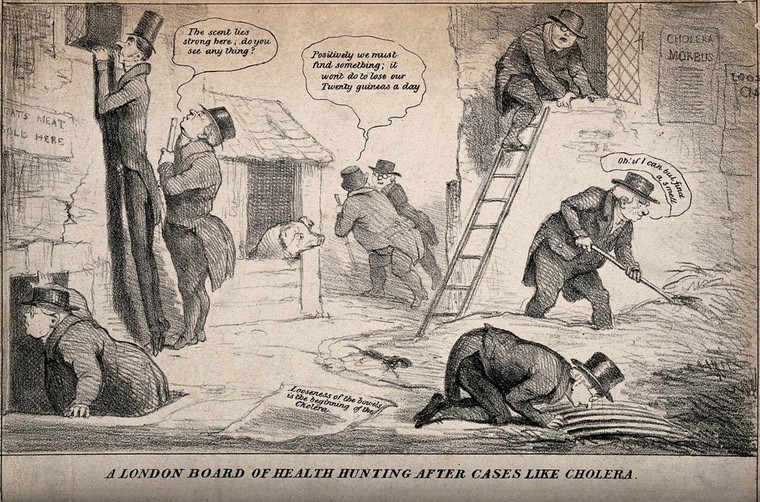
Then came cholera.
Cholera outbreaks in the nineteenth century terrified cities because the disease could kill quickly and brutally. Vomiting, diarrhea, dehydration, collapse—sometimes all within hours.
For many observers, the answer seemed obvious:
This must be miasma.
Cholera appeared in dirty, overcrowded places.
It devastated poor urban districts.
It followed conditions that looked and smelled appalling.
So of course people suspected bad air.
But cholera would become one of the diseases that most powerfully exposed the weakness of that explanation.
John Snow and the Water Problem
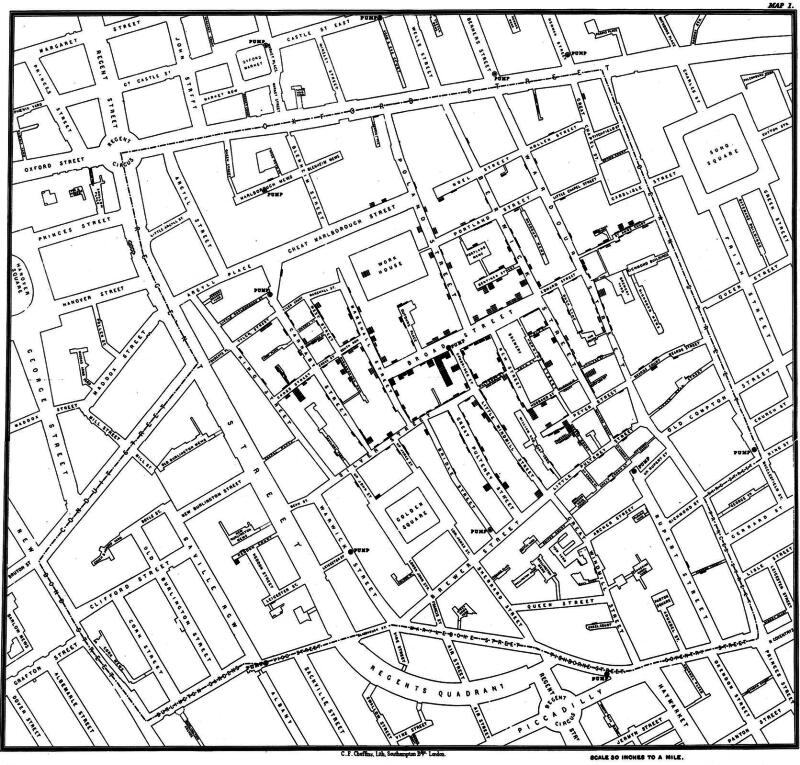
One of the most famous moments in public-health history involves physician John Snow and the 1854 cholera outbreak in London.
Snow argued that cholera was spread through contaminated water rather than by miasma.
That claim ran against dominant assumptions of the time.
But he investigated cases, mapped where deaths occurred, and focused attention on the Broad Street pump.
The story is often simplified into a heroic legend: Snow removes the pump handle, science wins, everyone applauds, bad air goes home defeated.
Real history is messier.
But the Broad Street investigation became iconic because it demonstrated something important:
Disease patterns could be traced more precisely than “the air here is bad.”
The outbreak fit a water source more convincingly than a cloud of corrupted atmosphere.
And that mattered.
Because once you can map the source of infection, you are no longer just talking about smell.
You are talking about transmission.
The Great Stink: When London Nearly Drowned in Its Own Theory
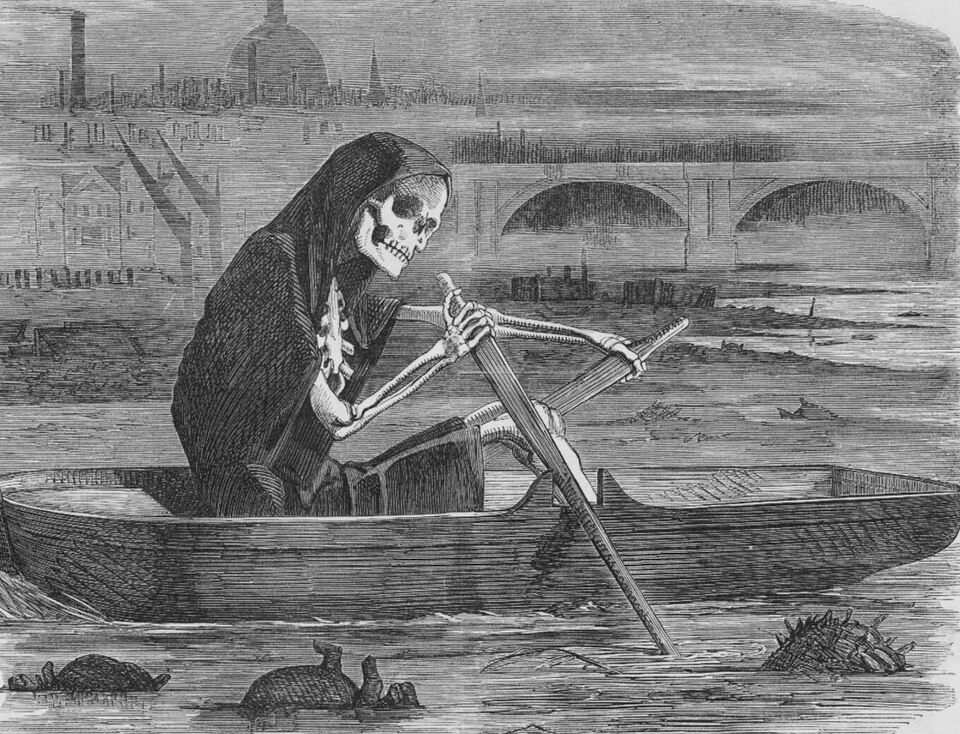
Nineteenth-century London was practically designed to make miasma theory feel correct.
Sewage flowed into the Thames.
The river stank.
Hot weather made it worse.
The event later remembered as the Great Stink of 1858 overwhelmed the city with unbearable odor.
If you already believed that foul air caused disease, London had just provided you with an enormous, steaming argument in your favor.
And yet the reforms that followed—especially improvements to sewers and sanitation—actually helped public health.
Again, this is the weird brilliance of historical medicine:
The explanation was flawed, but the response sometimes improved conditions anyway.
People cleaned cities because they feared poisoned air.
The result helped reduce waterborne and environmentally linked disease.
Wrong theory.
Useful consequences.
Semmelweis and the Hands Nobody Wanted to Blame

If John Snow challenged miasma through water, Ignaz Semmelweis challenged it through hands.
In the mid-nineteenth century, Semmelweis observed that women in one maternity clinic died of puerperal fever at much higher rates than women in another.
He eventually linked the difference to medical students and physicians moving from autopsies to labor wards without proper hand cleaning.
His solution—handwashing with chlorinated lime—reduced deaths dramatically.
Semmelweis did not possess a full modern germ theory in the later Pasteur-Koch sense, but his work showed that something material was being transferred by contact.
That was a serious problem for the idea that epidemic disease could simply be blamed on foul atmosphere.
If death clung to the hands of doctors, then “bad air” was clearly not the whole answer.
Also: few things in medical history are more tragic than being correct and still being ignored.
Florence Nightingale and the Complicated Middle Ground
This period is interesting because beliefs did not flip overnight from “bad air” to “germs.”
There was overlap, confusion, and contradiction.
Many nineteenth-century reformers accepted some form of miasmatic thinking while also promoting measures that genuinely improved health:
- ventilation
- drainage
- cleanliness
- fresh water
- waste removal
- cleaner hospitals
Florence Nightingale is a classic example of this complicated middle ground. She emphasized sanitation, cleanliness, and ventilation and worked within a medical world still heavily influenced by miasmatic ideas.
So even when the biological explanation was incomplete, the environmental reforms could still save lives.
Medical history is often less about sudden revelation and more about people stumbling toward a better model while dragging pieces of the old one with them.
So When Did Germ Theory Win?
Not all at once.
That is the annoying but honest answer.
During the nineteenth century, evidence accumulated through the work of people like Snow, Semmelweis, Pasteur, and Koch.
Gradually, disease came to be understood less as a vague atmospheric corruption and more as something caused by specific living agents—microorganisms—with identifiable routes of transmission.
That shift changed everything.
Suddenly disease was no longer just a quality of place.
It could be:
- a bacterium
- a virus
- a pathogen in water
- a contaminant on hands
- an organism entering the body
This did not mean environment stopped mattering.
It meant environment now mattered partly because it influenced where pathogens lived, multiplied, and spread.
That is a much sharper explanation.
Was Miasma Theory Completely Useless?
No—and that is part of what makes it so historically important.
Miasma theory was wrong as a scientific explanation of infectious disease.
But it was not useless.
It encouraged attention to:
- sanitation
- drainage
- sewage
- ventilation
- housing conditions
- urban crowding
- public cleanliness
Those concerns became central to public health.
So while miasma theory did not discover microbes, it helped create the social and political pressure for cleaner cities.
That matters.
A bad theory can still sometimes point people toward useful action.
Just not for the reasons they think.
From the Old World of Bad Air
If you stood in a nineteenth-century alley overflowing with sewage while cholera ripped through the neighborhood, you probably would have blamed the air too.
The place smelled like death.
It looked like death.
And death kept happening there.
The problem was not that people observed nothing.
It was that they lacked the invisible piece of the puzzle.
They could see filth.
They could smell decay.
They could not yet see bacteria.
The Legacy of a Wrong Idea
Miasma theory eventually lost the scientific argument.
But its legacy remained.
It shaped how cities were redesigned.
It influenced hospital reform.
It strengthened sanitation movements.
It helped make public health a matter of environment, infrastructure, and collective responsibility.
And perhaps most importantly, it reminds us that a theory can be both:
wrong in explanation
and
important in consequence
Sources & Further Reading
Primary historical direction
- Hippocrates — On Airs, Waters, and Places. One of the earliest surviving medical texts to connect health with climate, winds, water, and local environment. The MIT Classics Archive has the full English translation online.Read On Airs, Waters, and Places at MIT Classics
- John Snow — On the Mode of Communication of Cholera (1855)Snow’s expanded second edition laying out his argument that cholera spread through contaminated water rather than miasma. The digitized 1855 edition can be read online through Open Library/Internet Archive.Read John Snow’s 1855 book
- John Snow’s 1854 Cholera MapThe original map showing cholera deaths clustered around the Broad Street pump is available through the U.S. National Library of Medicine and is identified there as public domain. View John Snow’s cholera map
- CDC — John Snow and the Broad Street Pump. A concise modern overview of Snow’s investigation, his interviews with residents, the Broad Street pump, and why his work became so important to epidemiology. Read the CDC history of John Snow and cholera
- Ignaz Semmelweis — The Etiology, Concept, and Prophylaxis of Childbed Fever
- Semmelweis’s work on puerperal fever and the transmission of disease by contaminated hands. An English edition is catalogued through Open Library and Internet Archive. Read about Semmelweis’s Childbed Fever work
- Florence Nightingale — Notes on Nursing Especially useful for her emphasis on ventilation, fresh air, cleanliness, and sanitary conditions. Project Gutenberg provides the full text, including the opening section on ventilation and warming. Read Notes on Nursing at Project Gutenberg
- Florence Nightingale — Notes on Hospitals. For readers interested in how nineteenth-century hospital design, ventilation, sanitation, and overcrowding were being rethought during the transition away from older disease theories. A digitized historical edition is available through Open Library. Read Notes on Hospitals