
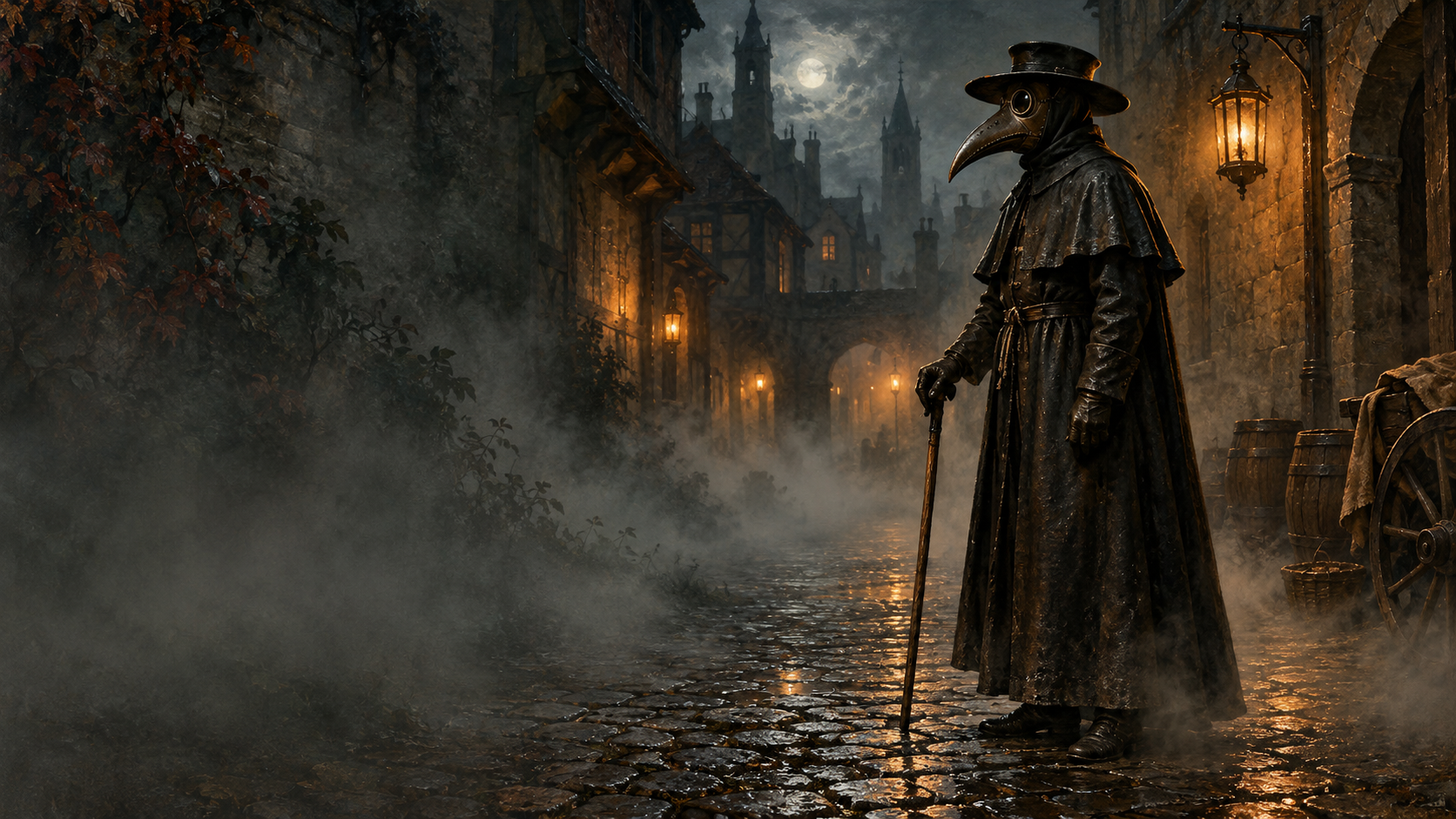
Why Did Plague Doctors Wear Beaked Masks? The Strange Truth Behind the Costume
A long black coat. A wide hat. Glass eyes. And that beak.
The plague doctor might be the creepiest outfit in all of medical history. Every October, it pops up at Halloween parties, and every year someone says, “That’s what doctors wore during the Black Death.”
Here’s the twist: they didn’t. Not during the Black Death, anyway.
The beaked mask is real, but it showed up about 300 years later. And the reason behind it is stranger than the costume itself. Doctors weren’t hiding their faces. They were trying to breathe through a bird-shaped bouquet.
Let’s open up the beak and see what was inside.
Did Plague Doctors Wear Beaked Masks During the Black Death?
No. This is the biggest plague doctor myth, and almost everyone believes it.
The Black Death swept through Europe between 1347 and 1351 and killed tens of millions of people. Plague doctors did exist back then. In Avignon, Pope Clement VI hired extra doctors just to treat the sick.
But there’s no evidence any of them wore a beak. Medieval plague doctors simply dressed like doctors.
The famous costume belongs to a much later chapter. Plague kept coming back to Europe in waves for centuries, and the beak first shows up in the 1600s. So if you picture a beaked figure walking through a medieval village, you’ve mixed up two very different centuries.
It’s a bit like picturing Shakespeare holding a smartphone. Close-ish in vibes. Wrong in history.
Who Invented the Plague Doctor Costume?
The outfit is usually credited to Charles de Lorme, a French physician who looked after royalty, including King Louis XIII.
De Lorme was a big name. He served three French kings and lived into his nineties, which is impressive for anyone in the 1600s, let alone someone who spent time around plague patients.
The first written description of the costume links it to a plague outbreak in Paris in 1619. According to the account, De Lorme designed a full-body outfit made of Moroccan goat leather: boots, breeches, a long coat, a hat and gloves.
Whether De Lorme truly invented it, or just made it famous, is still debated. Either way, the look caught on. By the mid-1600s, beaked doctors were turning up in Italy, and by 1720 a version of the outfit was recorded during the plague in Marseille, France.
Think of it as one of history’s first hazmat suits. Built on completely wrong science, but a hazmat suit all the same.
The Plague Doctor Costume, Piece by Piece
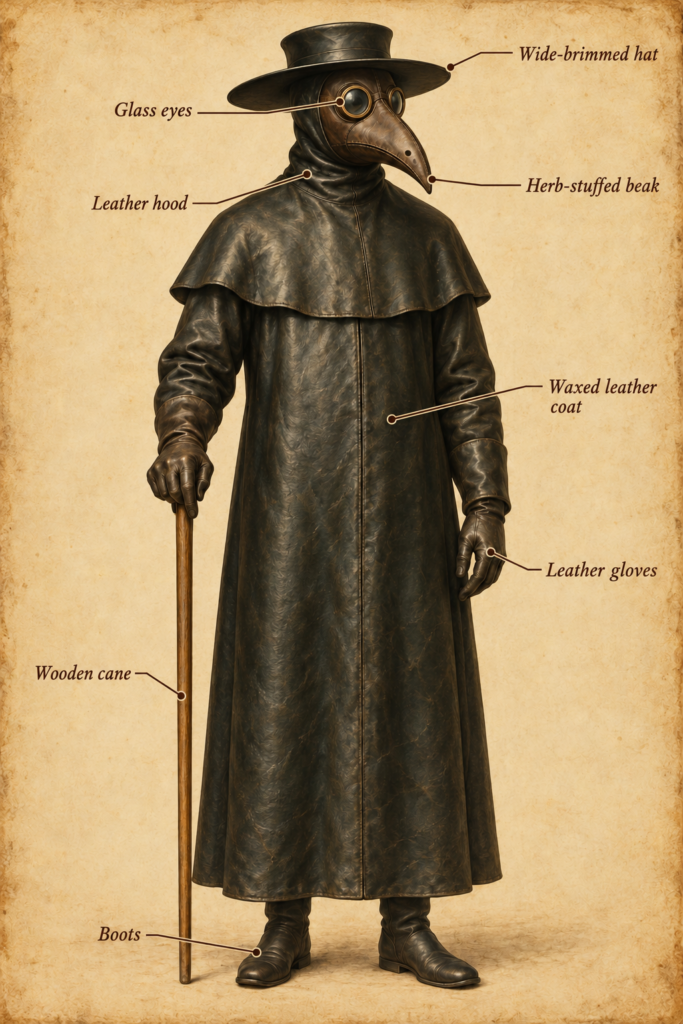
Every part of the outfit had a job. Here’s what each piece was meant to do:
- The beak mask. About half a foot long, with two tiny breathing holes near the nostrils. It was stuffed with sweet-smelling herbs (more on that below).
- Glass eye openings. Round lenses covered the eyes, so no “bad air” could sneak in that way. They also made the wearer look like a giant, unblinking bird. Probably not great for patient comfort.
- The wide-brimmed hat. Leather hats helped mark the wearer as a doctor. Basically a uniform you could spot from the end of the street.
- The long coat. Ankle-length, made of leather or heavy fabric, often coated in wax. The idea was that nothing nasty could cling to a slick surface.
- Gloves, boots and breeches. Head-to-toe coverage. Not a single patch of skin showing.
- The wooden cane. Doctors used it to examine patients, point at things, lift clothing and keep people at a distance, all without touching anyone. Some accounts suggest it also came in handy for fending off desperate crowds.
Put it all together and you get a doctor who looked less like a healer and more like death making a house call. No wonder people were terrified when one knocked on the door.
What Was Inside the Plague Doctor’s Beak?
This is where it gets weird.
In the 1600s, most doctors believed disease spread through “bad air,” a theory called miasma. Rotting bodies, swamps and garbage gave off foul smells, and those smells were thought to carry sickness straight into your lungs.
So the logic went like this: if bad smells make you sick, good smells should protect you.
The beak was basically a portable air freshener. Doctors packed it with strong-smelling ingredients like:
- Dried flowers and rose petals
- Lavender and mint
- Cloves, cinnamon and camphor
- Myrrh and storax (fragrant tree resins)
- Sponges soaked in vinegar
- Theriac, an ancient “cure-all” paste with dozens of ingredients, sometimes including powdered viper flesh

Yes, some plague doctors may have been breathing through snake.
The long beak had a purpose too. The thinking was that the extra length gave the air time to pass through the herbs and get “cleaned” before it reached the doctor’s nose.
Who Were the Plague Doctors, Really?
You might imagine plague doctors as brave, top-trained physicians. Some were. Many were not.
When plague hit a town, the regular doctors often fled or refused to go near the sick. So towns hired special plague doctors under contract. Their job was to treat plague patients, and only plague patients.
That job came with a lot of fine print. Contracts spelled out pay and duties, and often required doctors to treat the poorest patients for free. Some contracts also kept doctors in quarantine so they wouldn’t spread the disease around town.
And who signed up for that? Often whoever was available. Some plague doctors were young doctors fresh out of training. Some were doctors who struggled to find other work. Some had no medical training at all. They were simply the only ones willing to do it.
Their work wasn’t only medical, either. Plague doctors also counted the dead and kept records. Not exactly a dream job. It paid, it was dangerous, and many of them didn’t survive it.
Did the Plague Doctor Mask Actually Work?
Short answer: not the way they thought.
Plague isn’t caused by bad smells. It’s caused by a bacterium called Yersinia pestis, which wasn’t identified until 1894. It mostly spreads through bites from infected fleas, often carried by rats. One form of plague, pneumonic plague, can also spread person to person through the air.
So all those rose petals and cloves did nothing against the actual germ. The treatments plague doctors used, like bloodletting and herbal remedies, didn’t do much either.
But here’s the funny part. The costume may have helped a little, completely by accident.
- A long, waxed leather coat is a hard surface for fleas to bite through.
- Gloves and boots meant less exposed skin.
- The mask put a barrier between the doctor’s face and a coughing patient.
- The cane kept a bit of distance.
They had the right idea for all the wrong reasons. It’s one of medical history’s best examples of getting lucky.
Still, “a little” is the key phrase. Plenty of plague doctors caught the disease and died anyway.
How the Plague Doctor Became a Halloween Icon
Even in the 1600s, people found the costume a little ridiculous. Plague doctors quickly became the subject of dark jokes and satirical cartoons. When someone in a beak showed up on your street, everyone knew what it meant: death was nearby.
The look became especially famous in Italy. The plague doctor turned into a stock character in Italian street theatre called commedia dell’arte. Today, the Medico della Peste mask is one of the classic costumes at the Carnival of Venice.
From there, the beak went everywhere: Halloween stores, horror games, steampunk fashion and, during the COVID-19 pandemic, a lot of very dark memes.
It’s a strange afterlife for a piece of medical gear. A costume meant to protect people from death became one of the most recognizable symbols of it.
The Real Thing: “Doctor Beak of Rome” (1656)
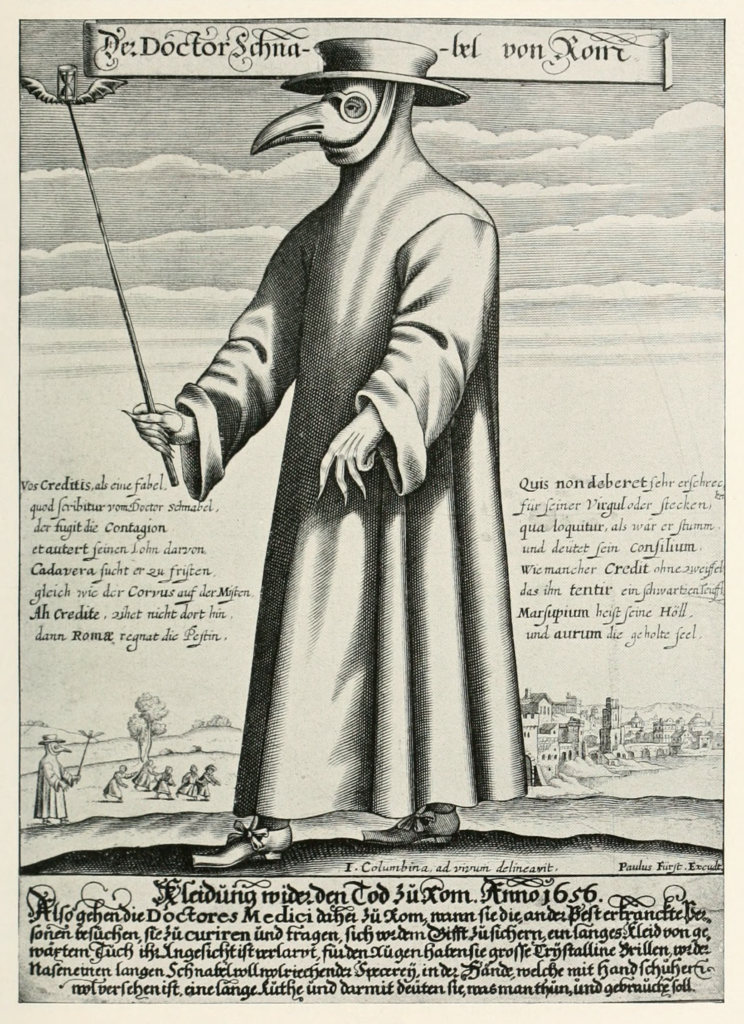
Most of what we picture today comes from this one image.
In 1656, a deadly plague hit Rome and Naples. That year, German publisher Paul Fürst released an engraving called Der Doctor Schnabel von Rom, which translates to “Doctor Beak of Rome.” It shows the full outfit: the beak, the hat, the long coat and the cane.
Here’s the fun detail. It wasn’t a medical illustration. It was satire. The print came with a mocking poem poking fun at plague doctors and the fear they caused.
So the most famous picture of a plague doctor ever made was, essentially, a 17th-century meme.
A few surviving masks claimed to be from this era are also on display in museums, including one at the German Historical Museum in Berlin.
Plague Doctor FAQ
Why did plague doctors wear masks?
To protect themselves from “bad air,” which they believed spread disease. The beak was filled with herbs and spices meant to clean the air before they breathed it.
What was in the plague doctor mask?
Dried flowers, lavender, mint, cloves, camphor, myrrh, vinegar-soaked sponges, and sometimes theriac, a cure-all paste that could include viper flesh.
Did plague doctors exist during the Black Death?
Yes, but they didn’t wear the beaked costume. That came about 300 years later, in the 1600s.
Who invented the plague doctor costume?
It’s usually credited to Charles de Lorme, a French royal physician, around 1619.
Did the plague doctor costume work?
Not for the reasons doctors believed. But the full leather coverage may have accidentally offered some protection from flea bites.
Why do plague doctors carry a cane?
To examine patients and move clothing without touching them, and to keep people at a distance.
Are plague doctors still around?
Only as costumes. You’ll see them at the Carnival of Venice, on Halloween and all over pop culture.
The next time you see a beaked costume at a Halloween party, you’ll know the truth. It’s not a medieval monster. It’s a 17th-century doctor, breathing through a nose full of flowers, hoping for the best.
Further Reading
- Plague doctor, Encyclopaedia Britannica
- Why plague doctors wore those strange beaked masks, National Geographic
- Plague doctors: Separating medical myths from facts, Live Science
- Doctors didn’t actually wear beaked masks during the Black Plague, Mental Floss
- Charles Delorme, Art UK
- Plague doctor image record, US National Library of Medicine